
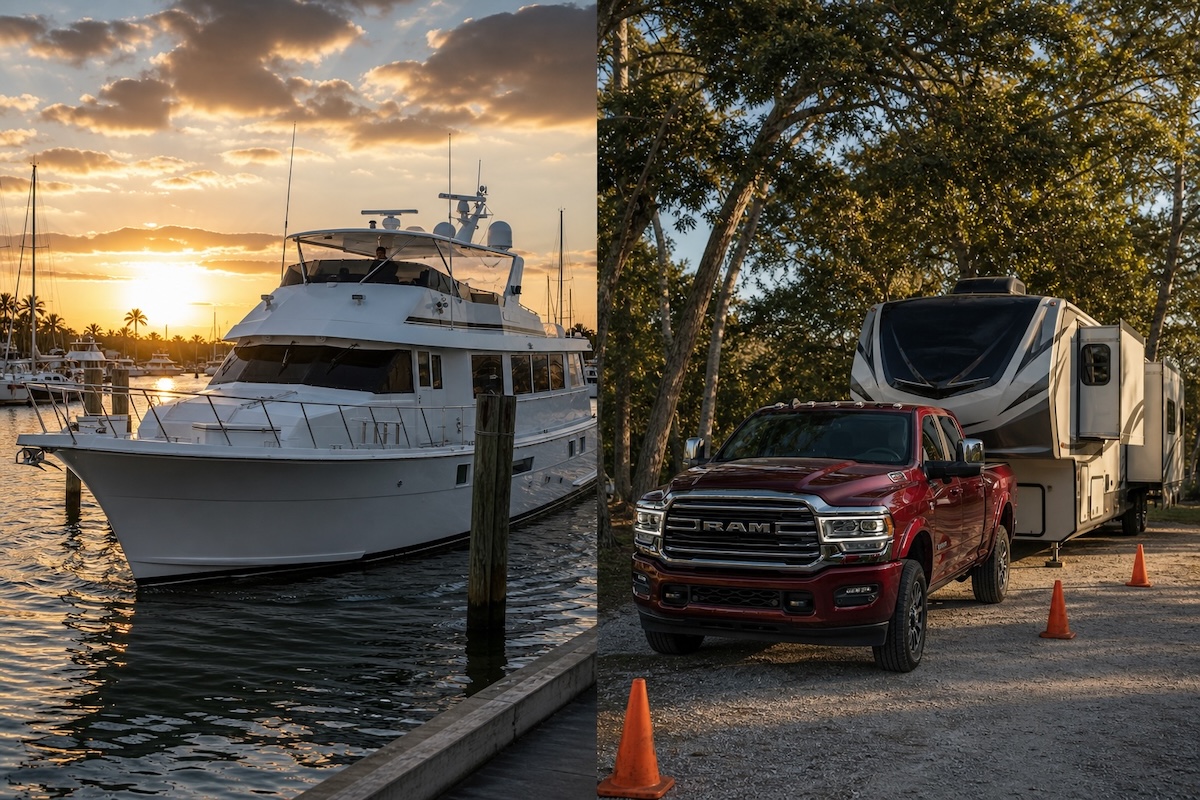
Docking a Yacht Made My Trailer-Backing Better: Crossover Skills You Can Practice This Weekend to Save Your Gelcoat and Your Bumper
I used to think docking a 74-foot Hatteras and backing a long trailer were two different jobs. Then a gusty afternoon in a tight marina taught me otherwise. Sliding the motor yacht Empire sideways against a crosswind felt exactly like persuading a camper to snake into a narrow site. Same pressure. Same physics pretending to be chaos. Same skills deciding whether you touch a dock with paint or kiss a post with your bumper.
Here are the crossover skills that made me better at both—and how you can practice them this weekend without scraping anything.
The Big Idea: Control Vectors, Not Just Wheels
Yacht docking and trailer-backing are both vector games. Boats slide. Trailers articulate. If you plan and control the vector—angle, speed, and where the pivot is—you look like a magician. If you chase the bow or chase the trailer, you look like YouTube content.
-
Know your pivot point:
- Boat: The pivot is forward of midships when moving; in neutral, the whole hull drifts.
- Trailer: The pivot is the hitch ball; once it breaks angle, it accelerates into a jackknife.
-
Move slowly enough to think:
- Boat: Use idle and short bursts. Neutral is your friend.
- Trailer: Back in at a crawl; pause to let the trailer “settle” after each tiny input.
Crossover Skill #1: Set the Approach, Don’t Fix It Later
On Empire, a clean docking starts 200 yards out. On the road, a clean back-in starts before you put it in reverse.
- Boat: Line up with the slip at a shallow angle. Account for wind and current early.
- Trailer: Pull far forward and swing out so your trailer is already aimed down the lane before reversing.
Practice drill:
- Parking lot with cones: Create a “slip” and a “campsite.” Practice wide setup arcs so entry is almost straight. If you’re correcting more than 15 degrees while reversing, your setup was wrong.
Crossover Skill #2: Small Inputs, Then Wait
Over-steering is the universal rookie mistake. Docking and reversing both punish impatience.
- Boat: Bump ahead/astern for one second. Center the wheel. Watch how the boat “answers” before your next move.
- Trailer: Put your hand at the bottom of the steering wheel. Move it a few inches in the direction you want the trailer to go, then pause to let the angle develop.
Practice drill:
- Count “one-one-thousand” between inputs. The goal is fewer, smaller moves—not hero saves.
Crossover Skill #3: Aim the Back End
What matters is where the stern (or trailer) ends up. Drive the back end; catch the front with small corrections.
- Boat: If your stern is drifting off the dock, push the stern first, then correct the bow.
- Trailer: Watch the trailer’s wheels and tail, not your hood. Steer to place the trailer; the truck will follow.
Practice drill:
- Tape a “target line” on the ground. Keep the stern fender or trailer wheels riding that line for 30 feet.
Crossover Skill #4: Read the Invisible Forces
Wind and current on the water. Slope, camber, and crosswind on land. Both create silent drift.
- Boat: A 10-knot crosswind on a high-sided yacht is real. Plan a crab angle and let the wind do part of the turn.
- Trailer: Sloped campground pads pull your trailer. Crosswinds push tall rigs. Use the grade/wind to help the arc rather than fighting it.
Practice drill:
- Hang a ribbon from your antenna (wind) and roll a small ball across the parking lot (slope). Pick an approach that uses, not resists, those forces.
Crossover Skill #5: Communicate Like a Pro
Chaos loves silence. Clear communication with your crew turns stress into system.
- Boat: Assign roles. One voice. Standard phrases: “Stop,” “Bump ahead,” “Hold,” “Spring on.”
- Trailer: One spotter. Agreed hand signals or radios. “Stop” means stop, not “almost.”
Practice drill:
- Practice with radios (or headsets) at low stakes. If you can’t communicate calmly in a lot, you won’t at the ramp.
Crossover Skill #6: Build a Margin of Safety
Fenders and mirrors are cheap insurance. So is deciding to abort and try again.
- Boat: Fenders out early. Lines ready and flaked. If the angle looks wrong, go around.
- Trailer: Use tow mirrors and a rear camera. If the angle gets ugly, pull forward and reset. No pride dents today.
Practice drill:
- Set a “no-touch zone” with chalk. If you enter it, you must reset. Train your brain that resets are normal.
A Quick Story From the Empire
We slid into a tight end-tie with a 15-knot beam wind waiting to peel us off. Old me would have chased the bow. New me drove the stern onto a midship spring first, neutral, let the wind pin us gently, then walked the bow in with short bursts. The hull never kissed the dock—fenders did their job. That exact “stern first, let physics help” mindset later saved my taillight backing a long cargo trailer into a narrow barn: aim the trailer, pause, let it settle, counter-steer to catch the arc, done. Same dance, different shoes.
Weekend Practice Plan (60–90 Minutes)
-
Set up:
- Six cones, chalk lines, a friend with a radio, and an empty lot.
-
Drills:
- Wide setup arc: Pull forward wide, reverse straight between cones. Repeat until the first 10 feet are dead-straight.
- Tiny-input reverse: Hand at wheel bottom; three-inch moves only. Pause between inputs.
- Target line: Keep the trailer wheels on a chalk line for 30 feet without over-correcting.
- Abort and reset: Intentionally get off-line, then practice calm pull-forwards to clean it up in one move.
-
Boat owners:
- Do the same mindset at the dock: spring-line practice, one-second throttle bumps, stern-first positioning, and go-arounds.
Gear That Quietly Helps (No Hype, Just Useful)
- Boat: Quality fenders, midship cleat/spring line, boat hook, gloves, and a handheld VHF for marina calls.
- Trailer: Convex tow mirrors, a rear camera or hitch cam, inexpensive cones, and clear spotter headsets.
- Either world: Painter’s tape or chalk to mark targets, and a small notepad to log what worked and what didn’t.
A Simple Pre-Dock / Pre-Back Checklist
- Walk the space: Depth, obstructions, slope, wind/current direction.
- Choose an approach angle and exit plan.
- Brief your crew/spotter with clear roles and phrases.
- Set protection: Fenders/mirrors/cameras ready.
- Commit to slow, small inputs and normalizing resets.
Docking a yacht teaches humility and precision. Backing a trailer rewards the same. Master the vector, respect the pivot, move slow, and communicate. Your gelcoat and your bumper will thank you.
Want more real-world boat and RV skills without the fluff? Follow Anchors to Axles for honest lessons from the dock, the engine room, and the campsite—and come along for the adventure.