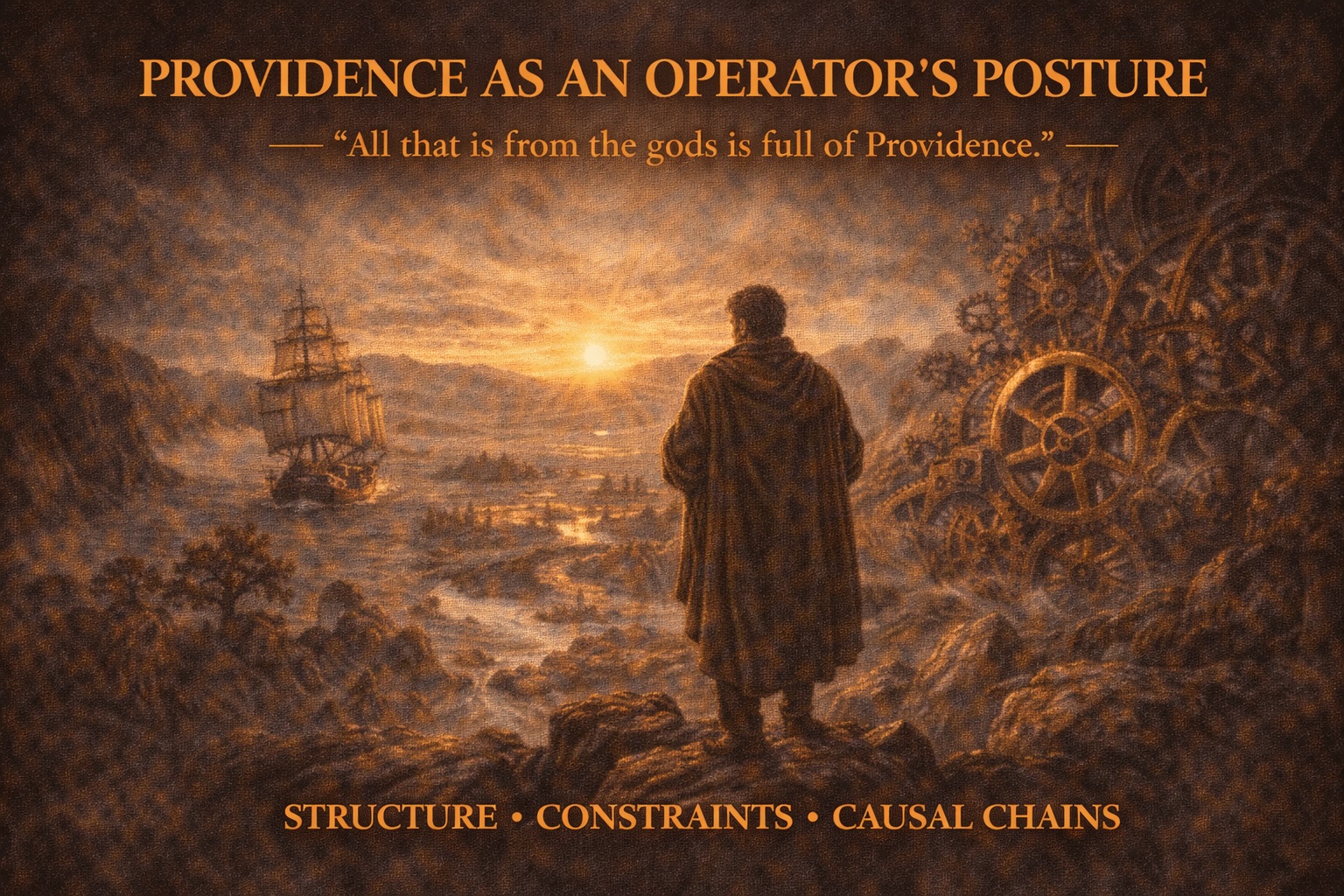
Providence as an Operator’s Posture
“All that is from the gods is full of Providence.”
Marcus Aurelius treats providence as the baseline condition of the world: order exists, whether we discern it or not. For a practitioner, this is not a theological claim so much as an operating posture. There are structures, constraints, causal chains, and feedback loops already in motion. Resenting them burns capacity. Accepting them clarifies what the situation asks of you.
This is the Stoic move that converts anxiety into agency. You replace moral outrage at circumstance with disciplined attention to what can be influenced right now.
What Providence Means in Practice
Read providence as “the given structure of reality.” At sea it’s weather and hull integrity. In software, latency budgets and failure modes. In leadership, human incentives and institutional inertia. You are not required to like these facts. You are required to work with them.
Acceptance is not passivity. It is contact with the actual. From that contact, you separate:
-
What is given: constraints that won’t move on your timeline.
-
What is influence: variables you can tilt with time, trust, and systems.
-
What is choice: actions under your direct control, here and now.
Clarity at these boundaries removes waste. Pride lives in the blurred zones.
Accept, Assess, Act
Under pressure, I rely on a simple loop.
-
Accept: Name the reality without spin. “We have 30 knots on the nose.” “The database is thrashing.” “We have six months of runway.”
-
Assess: What is the system state? What fails if we do nothing? What buys time? What introduces new risk?
-
Act: Decide inside your circle of control. Commit, communicate, execute, and monitor.
Three vignettes:
-
Bridge, approaching weather: The schedule is not real; the sea is. Acceptance resets the objective from “arrive by Friday” to “arrive intact.” The action might be to alter course, reduce speed, and burn more fuel. Pride would keep the throttle up. Providence asks for seamanship.
-
Production outage: Users are down. Accept the blast radius. Assess the most reversible intervention. Act with a rollback plan and a quiet channel. Providence here is the system’s actual behavior, not the design doc.
-
Cash runway: Markets do not care about your pitch. Accept the clock. Assess burn, revenue reliability, and debt. Act by cutting, sequencing, or seeking bridge financing. Providence is the constraint that forces prioritization.
In each case, acceptance accelerates competent action. Resentment delays it.
Designing With Order in Mind
If the world has order, design systems that respect it.
-
Make reality legible. Instrumentation, logs, and honest metrics beat narratives. What gets measured shapes attention.
-
Build buffers. Weather windows, error budgets, cash reserves. Buffer is humility expressed as margin.
-
Pre-commit to principles. Abort criteria, escalation paths, change windows. Decide the “rules of the game” before adrenaline shows up.
-
Rehearse failure. Drills, tabletop exercises, “rig for heavy weather.” Practice converts fear into fluency.
-
Prefer durability over speed. Fewer moving parts, clearer interfaces, slower growth you can actually absorb.
-
Write everything down. Orders, runbooks, checklists, after-action reviews. Writing externalizes judgment and compounds learning.
-
Review without theater. AARs that seek causes, not culprits. Learn the system’s story and adjust the system.
These are not hacks. They are concessions to providence: the world has grain; cut with it.
AI Inside Boundaries
Intelligent tools widen perception and compress time, but they don’t grant wisdom. Treat AI as amplification inside clear guardrails.
-
Use models to surface patterns, not to outsource decisions.
-
Keep human-in-the-loop for actions with ethical or safety weight.
-
Log model-influenced decisions and revisit them in reviews.
-
Install circuit breakers. If confidence drops or data drifts, degrade gracefully.
-
Favor explanations you can interrogate over outputs you can only accept.
Automation without understanding is fragile. Providence demands accountability: when the tool fails, someone is still responsible.
Resentment Is a Latent Bug
Resentment pretends to be resolve. In practice, it is a hidden drain on attention and judgment. Symptoms:
-
Re-litigating the constraint instead of navigating it.
-
Escalating tone when the system ignores your will.
-
Choosing expressive actions over effective ones.
A simple discipline helps: state the constraint aloud, state your intent, pick the next action. “The tide is against us. Our intent is safe arrival. We’ll wait an hour and transit on the flood.” The mind settles when duty is named and action follows.
Order Without Certainty
Affirming order is not claiming certainty. We will misread the pattern, design the wrong buffer, or push when we should hold. That is part of the work. Acceptance keeps you teachable. Responsibility keeps you honest. Integration—across roles, domains, and timelines—keeps you oriented on what endures.
“All that is from the gods is full of Providence” is a reminder to meet reality as it is, not as we wish it to be. From there, we earn whatever control is possible—and deserve the consequences of how we use it.
If this perspective is useful, subscribe to The Rissler Perspective to receive future essays on leadership, systems, and responsible judgment.