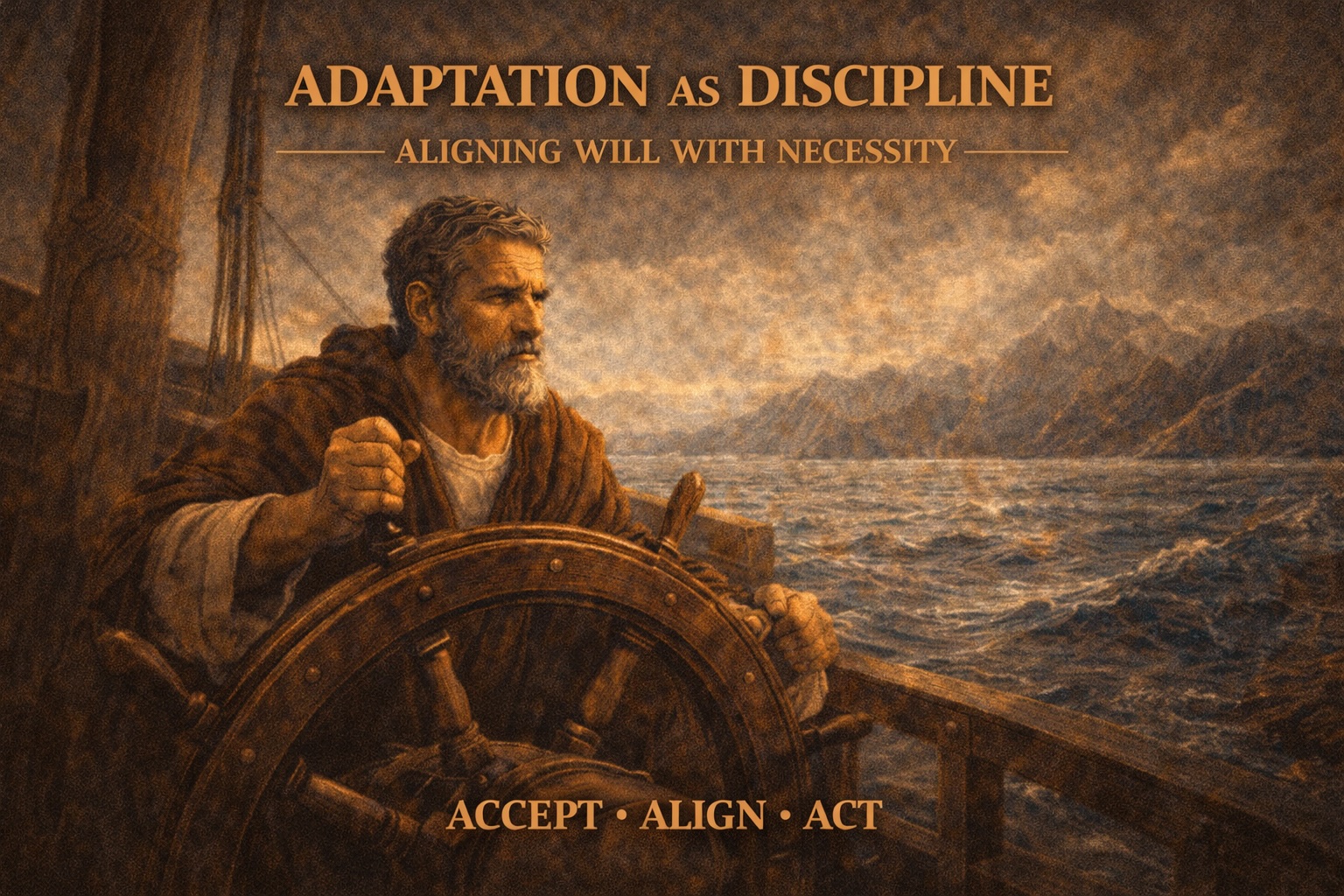
Adaptation as Discipline: Aligning Will with Necessity
“Adapt thyself to the things with which thy lot has been cast.” Marcus Aurelius’ line is not a surrender. It is a call to discipline. Acceptance is not passivity; it is alignment with reality so that judgment can do its work. Stoicism seeks accord between will and circumstance—not to excuse inaction, but to focus effort where it matters.
Across ships, software, and organizations, the pattern is the same: you don’t get to choose the sea state, the legacy system, or the macro environment. You do choose posture, priorities, and the next action. When the stakes are real, that distinction is the difference between theater and leadership.
What Acceptance Is—and Is Not
Acceptance means taking constraints as inputs, not verdicts. Resignation says “there’s nothing to be done.” Alignment says “there’s something to be done, but not everything.”
-
Acceptance is clarity: naming conditions as they are, without drama.
-
Acceptance is restraint: refusing to waste energy on what you don’t control.
-
Acceptance is commitment: using the reality you have to move the mission forward.
What it is not:
-
Permission to lower standards.
-
A reason to ignore weak signals, risks, or alternatives.
-
A moral cover for convenience.
Working With the Sea, the System, and the Situation
Three domains, one habit: harmonize your will with necessity.
On the water
You don’t argue with weather. A headwind is not a personal affront; it’s a vector. You adjust trim, speed, and course to keep a safe envelope. Sometimes the right decision is to wait on the hook for a weather window. Other times it’s to reroute and accept a slower arrival. Mastery isn’t bravado. It’s prudent control inside non-negotiable limits.
In software and systems
You inherit latency ceilings, budget constraints, and brittle interfaces. You can replace everything in theory; in practice you live with what must remain stable. Adaptation looks like:
-
Stabilizing the surface area before chasing new features.
-
Designing around the invariant (regulatory constraints, uptime SLOs).
-
Sequencing change in small, observable steps rather than heroic rewrites.
The system doesn’t care how elegant your intent was. It behaves according to its structure. So should you.
In leadership
Orders meet terrain. Plans meet people. The job is to translate intent into action under conditions that weren’t in the slide deck. That may mean revising the plan in contact, protecting your team’s attention, or pressing a hard truth upward. Alignment is choosing accuracy over appearances—especially when the room prefers the latter.
Treat Necessity as a Parameter, Not a Prison
In engineering, you don’t fight constants; you design around them. Leadership is similar. Build your approach on three anchors:
-
Invariants: What must not break? Identify the few things that define success or failure—safety, solvency, trust, mission intent. Hold those tight.
-
Variables: What can flex? Deadlines, scope, path, staffing, sequencing. Trade these deliberately to protect the invariant.
-
Feedback: How fast can you observe reality? Shorten the loop. Without feedback, “acceptance” becomes guesswork dressed as wisdom.
A practical loop under pressure:
-
See: Collect ground truth. Prefer direct observation to reports. Calibrate instruments and language.
-
Name: State the conditions and constraints plainly. Ambiguity in words becomes error in action.
-
Decide: Select the next reversible move that advances the mission without compromising invariants.
-
Act: Execute cleanly. Reduce partial work and context thrash.
-
Reassess: Compare expectations to outcomes. Update the model. Begin again.
This is not mystical. It’s a craft loop. Repeat it until the situation changes or the mission does.
The Line Between Adaptation and Excuse
Adaptation has a reputation problem because “realism” is often used to lower the bar. A quick test:
-
Are you protecting an invariant or avoiding discomfort?
-
Are trade-offs explicit and documented, or implied and forgotten?
-
Is the decision reversible? If yes, why the delay? If no, have you earned enough signal?
-
Who bears the cost? If the burden shifts silently to the least powerful, you’re rationalizing, not adapting.
Clarity without accountability is theater. Accountability without clarity is cruelty. Align them.
Humans and AI: Instruments, Not Oracles
AI amplifies judgment; it does not replace it. Adaptation here means placing the tool inside boundaries you can verify.
-
Treat models like instruments on a bridge: cross-check against other sources, know their failure modes, and never let them drive unsupervised into narrow waters.
-
Constrain scope: use AI where the cost of error is low and the feedback is fast. Expand gradually.
-
Keep provenance: log prompts, versions, and decisions so you can audit and learn.
-
Preserve human intent: define what “good” looks like before you automate, and keep a human responsible for outcomes.
Automation without understanding is fragile. The point of technology is to sharpen seeing and reduce noise so the next decision is better.
The Quiet Value of Limits
Limits concentrate attention. They force prioritization and reveal structure. On a boat, fuel range teaches humility. In a startup, a cash runway forces clarity. In an organization, political capital reminds you that timing is a resource. Limits are not enemies; they are the contours of the real world. When you work with them, you gain leverage. When you ignore them, you pay tuition.
Adapt thyself is not an argument for small thinking. It is an argument for durable thinking—action that survives contact because it was built with reality in the loop. The will aligns with circumstance so that it can move the circumstance, if only a degree at a time, in the direction of a better port.
If you lead, build, or navigate complexity, you don’t need louder courage. You need cleaner sight, steadier hands, and a habit of alignment.
Ready to explore these disciplines in practice? Subscribe to The Rissler Perspective for essays on leadership, systems, and judgment shaped by real constraints and real consequences.