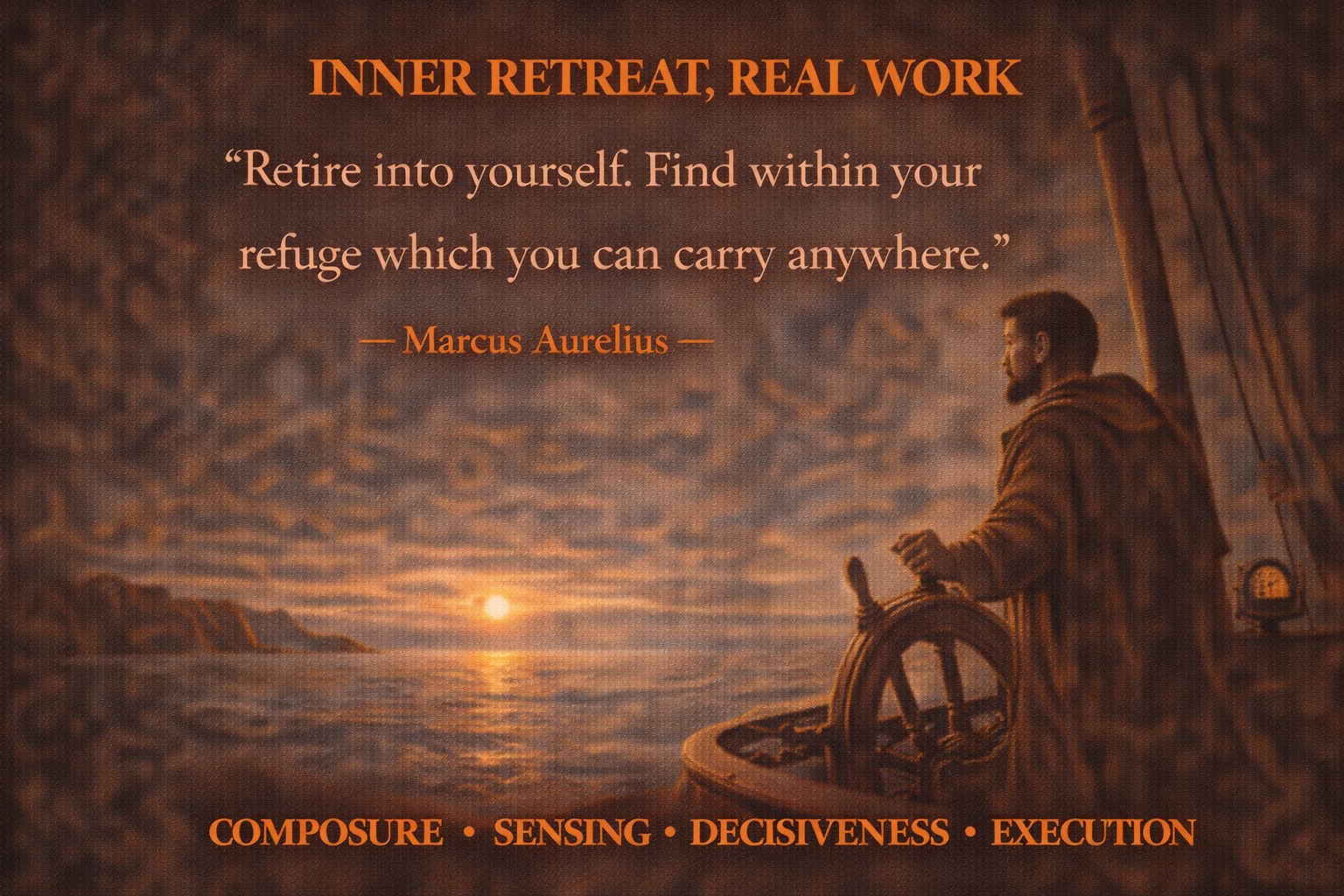
Inner Retreat, Real Work
Marcus Aurelius pointed out a habit that endures: when pressure rises, we look for escape—somewhere quieter, prettier, softer. Country houses become offsites, sea-shores become sabbaticals, mountains become “when things slow down.” He counters with a harder assignment: retire into yourself. Find in inner composure a refuge you can carry to the bridge at 2 a.m., the incident call, the board meeting, the shipyard.
This isn’t a romantic inwardness. It’s operational. A refuge built on responsibility, not detachment. The Stoic move is not to demonize circumstances but to remove dependence on them. The question becomes: how do you construct inner self-sufficiency that holds under load?
The Temptation of Elsewhere
Leaders and builders learn quickly that geography is a false fix for systemic issues.
-
A founder schedules a team retreat to restore focus; the roadmap is still incoherent on Monday.
-
A captain chases a calmer anchorage; the crew’s uncertainty follows because the plan is still ambiguous.
-
An architect switches tech stacks; the failure modes migrate because the boundaries and contracts remain undefined.
“Elsewhere” is relief without repair. It offloads sensation, not responsibility. What we need is a durable pattern: a way to steady the operator so the system steadies with them.
Retreat as a System, Not a Place
Treat inner composure like a control system you can design, test, and maintain. Four components matter:
-
Sensing: What signals reliably indicate reality now?
-
In a crisis, raw facts trump narratives: weather readouts, cash runway, system metrics, troop disposition.
-
Build a shortlist of trusted sensors before stress. Under pressure, you won’t invent them.
-
Orientation: How do those facts map to your purposes and constraints?
-
Values are not slogans; they are fixed reference points for tradeoffs.
-
Constraints are liberating: “We do not take on long-term obligations with short-term funding” is an orienting truth.
-
Rules of engagement: What decisions are reversible, and what are not?
-
Move fast on reversible choices; slow down on one-way doors.
-
Predefine thresholds that trigger action to reduce dithering when ambiguity spikes.
-
Actuation: Who does what, when?
-
Clear roles and minimum viable orders: “You own damage control. Three checkpoints. Report at 20, 40, 60 minutes.”
-
Close the loop with debriefs that update sensors and rules. The system learns or it drifts.
Inner retreat lives here. It’s a practiced loop you can run anywhere: sense, orient, decide, act—without theatrics, without waiting for ideal conditions.
Building an Inner Wheelhouse
On a boat, the wheelhouse is quiet by design. Instruments have hierarchy. The chart is visible, the comms disciplined, the watch routine enforced. The inner equivalent is less romantic and more deliberate:
-
A short list of non-negotiables: duty to people, integrity in data, disciplined communication.
-
A daily log: what was observed, what was decided, what changed. Memory under stress is unreliable; logs make judgment visible.
-
A standing plan and a standing downshift: how we operate normally, how we shift when alarms hit.
-
A personal checklist for composure: a brief you run before acting when stakes rise.
The point isn’t perfection. It’s predictable behavior under uncertainty—so your team can anchor to you when the outside world won’t cooperate.
Drills for Composure Under Load
Training turns advice into reflex. A few compact drills that scale across domains:
-
Three-breath reset: Exhale longer than you inhale, three times. Then state the problem in one sentence. Physiology first, then clarity.
-
One-fact test: Name the single most decision-relevant fact you know for sure. If you can’t, you’re debating fiction.
-
Pre-commit thresholds: “If X metric crosses Y, we suspend feature work and shift to stability.” Write them before you need them.
-
Two-sentence order: Define intent and the first action. “Intent: stabilize cash for 90 days. First action: freeze hiring and reforecast by Friday.”
-
Reversible/irreversible split: List options. Mark which you can undo. Execute reversible ones immediately to learn quickly.
-
Premeditation of failure: List the top three plausible ways this plan fails. Add a countermeasure for each before kickoff.
-
After-action minute: Immediately note what surprised you, what you’d do again, what you’d stop. Small, fast learning beats post-mortem theater.
None of these requires a cabin in the woods. They require attention, constraint, and repetition.
Guardrails Against Productive Escape
Not every “retreat” looks like a beach. Some wear the mask of diligence:
-
Tool churn as avoidance: new platforms instead of clearer interfaces and contracts.
-
Meetings as sedation: ritual updates with no decisions or thresholds.
-
Research as delay: more inputs without a stronger stance.
A useful question: does this action increase our ability to make and keep commitments under uncertainty? If not, it’s noise.
Humans and AI: Amplifiers, Not Havens
Intelligent tools can sharpen the inner retreat or short-circuit it. Use them to reduce noise, not to outsource judgment.
-
Frame before you prompt: state intent, constraints, and success criteria. Otherwise the system amplifies your confusion.
-
Demand alternatives with tradeoffs, not answers. Your role is to choose, own, and refine.
-
Keep decisions human when ethics, intent, or accountability are at stake. AI may propose, you dispose.
The measure is simple: does the tool increase clarity and speed the control loop without eroding responsibility?
Leadership Is Contagion
A leader’s inner state propagates through a team like a signal through a network. Calm anchored in reality reduces variance. Panic injects noise and tight coupling, which produces cascading failures. When you carry your refuge with you, you become a stable reference for others:
-
You stop importing anxiety into the system.
-
You model decisions tied to principles, not adrenaline.
-
You make room for other people’s best judgment to surface.
Composure is not aesthetic. It’s an operational asset.
A Short Protocol for Real Life
When the room heats up, run this:
-
Stop and breathe out. Then name the problem in one sentence.
-
Identify one confirmed fact, one core constraint, and one acceptable outcome.
-
Split options into reversible and irreversible. Act on one reversible option now.
-
Issue a two-sentence order with intent and first step. Set a near checkpoint.
-
After the checkpoint, run a one-minute debrief. Update the log, adjust thresholds, continue.
That’s a retreat you can execute at a terminal, on a bridge, in a hangar, or in a boardroom. It travels. It scales. It holds.
If Marcus is right—and experience suggests he is—the only refuge worth seeking is the one you can build, maintain, and carry. Not a place. A practice. Not an escape. A system.
Looking to build steadier systems and steadier leadership? Subscribe to The Rissler Perspective for field-tested essays on clarity, responsibility, and decision-making under pressure.