
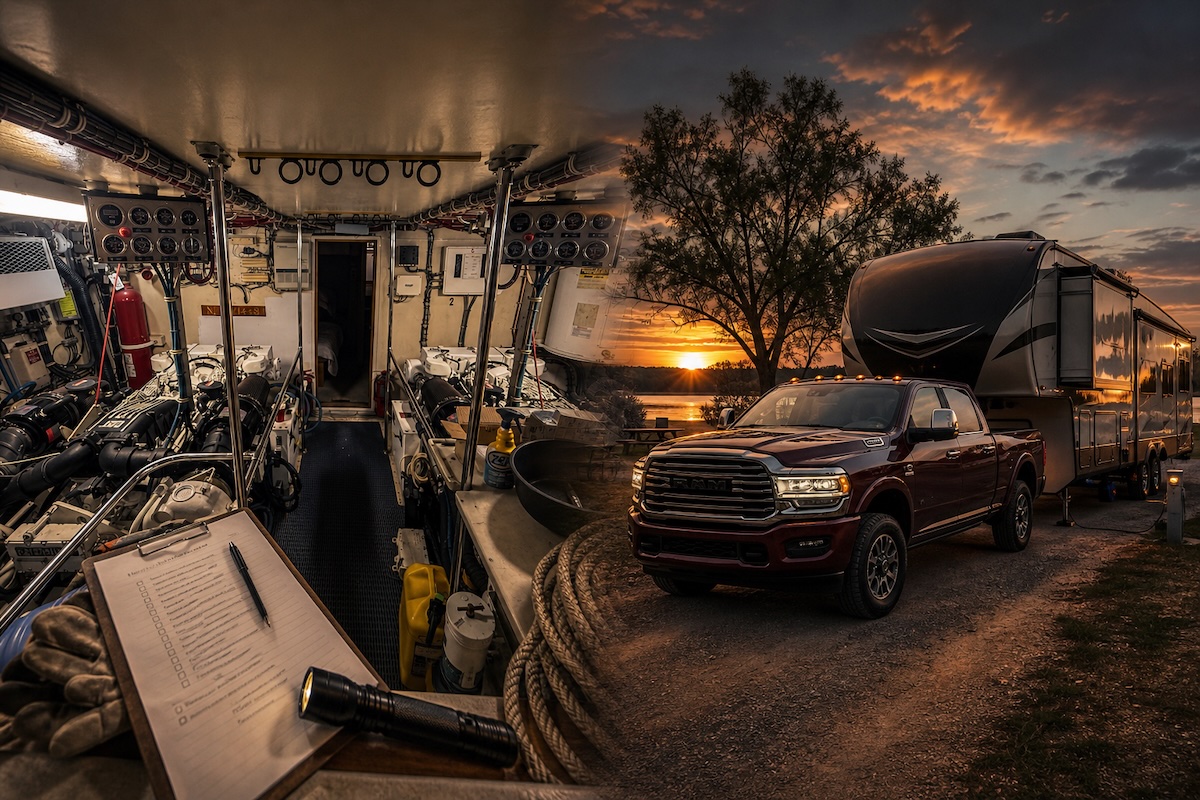
The Pre-Departure Double Checklist: A 12-Minute Routine That Prevents 90% of Mishaps on a Boat or an RV (and the One Step People Always Skip)
Every memorable day on the water or the road starts with the same thing for us: 12 focused minutes. Two quick passes—one setup, one hands-on—catch the dumb mistakes before they become expensive problems. We’ve run this routine on both sides of our life: leaving a marina aboard our 74-foot Hatteras motor yacht, Empire, and pulling out of a campsite with the tow rig ready to roll. It’s not glamorous, but it’s exactly what keeps the adventure fun.
Why the “double” works
- Single checklists rely on memory; the second pass relies on touch. That’s the difference between “looks good” and “is good.”
- It’s fast. Six minutes to set systems, six minutes to verify. No overthinking, just flow.
- It prevents 90% of the mishaps we’ve personally made or witnessed: dragging cords, open hatches, mis-set valves, missed pins, unlatched compartments, and unsecured gear.
The 12-minute routine at a glance
Two passes. Same logic for both a boat pre-departure checklist and an RV pre-departure checklist.
Pass 1 (6 minutes): Systems Prep
Boat (dockside):
- Power and fluids: shore power off and stowed, water hose disconnected, fuel and water levels checked, generator status confirmed.
- Engine room: quick hands-on leak and belt check, seacocks in correct positions, bilge dry, strainers clear.
- Nav and comms: plotter up, VHF on correct channel, AIS/lights set for conditions.
- Deck and tender: fenders staged for departure side, dinghy drain plug in, anchor locked, anchor locker latched.
- Interior secure: hatches and ports dogged, galley secured, cabin doors latched, loose gear stowed.
RV/Tow (campsite):
- Utilities: power unplugged and stowed, water and sewer disconnected and caps on, propane set, water heater off if needed.
- Slides, jacks, and steps: slides in and locked, stabilizers up, steps stowed, awning locked.
- Hitch and tow: ball height/right drop, coupler seated, pin/clip installed, weight distribution bars on, safety chains crossed, breakaway cable attached, 7‑pin connected.
- Brakes/tires: trailer brake gain set, tires and visible lug indicators checked, mirrors and cameras on.
- Interior secure: cabinets latched, fridge locked, cargo tied down.
Pass 2 (6 minutes): The Hands-On Departure Check
This is the walkaround where you physically touch every point that can bite you.
Boat:
- Tug-test every line, fender, and cleat. Confirm spring lines last to release.
- Physically pull on shore power plug and water hose—are they onboard and stowed?
- Hand on each hatch, port, and locker latch; verify anchor safety pin or chain stopper is engaged.
- Glance at exhaust water flow on start, smell for fuel, listen for belt squeal.
- Final bow-to-stern look: antennas down or up as needed, dinghy secure, nav lights actually on.
RV/Tow:
- Tug-test hitch coupler, verify latch locked and pin installed, safety chains tensioned, breakaway cable independent of chains.
- Pull-test trailer brakes at low speed; confirm gain and function.
- Hand on every exterior latch, bay door, slide lock, and vent cap.
- Check steps, awning locks, TV/radio/Starlink antennas, bikes and cargo straps.
- Walk back and count: chocks stored, wheel leveling blocks packed, caps on all ports.
The one step almost everyone skips
The second pass. People do a visual, then get distracted by neighbors, lines, traffic, wind, or excitement—and they leave without the tactile walkaround. The hands-on check is where you catch:
- A coupler that looked seated but wasn’t actually locked.
- A dock line still looped around a cleat under the rail.
- A dinghy plug missing, a livewell valve open, or a seacock in the wrong position.
- An exterior bay door that “looked” closed but wasn’t latched.
- A 7‑pin that’s half-in, a breakaway cable clipped to a safety chain instead of the frame.
- A shore power cord hiding under a fender (ask us why we touch that twice).
Make it a ritual: nobody casts off or puts the truck in gear until the hand-check is complete and called out.
Common gotchas this routine catches (before they cost you)
- Boat: shore power still connected, raw-water seacock closed on startup, anchor not secured, fenders stowed too early, tender painter in the prop, flybridge hatch ajar, lines fouling the rudder.
- RV: stabilizers up but steps out, antenna up, fridge unlatched, cargo bay open, sewer cap off, equalizer pins missing, brake gain at zero, chocks left behind.
- Both: unsecured loose gear, poor weight distribution, tools left in the engine bay, vents/ports open to rain, wrong lights for conditions.
Pro tips to make the 12 minutes stick
- Assign roles. One person runs systems, one runs the hands-on pass; swap weekly to stay sharp.
- Call-and-response. “Shore power off?” “Off and aboard.” “Hitch pinned?” “Pinned and clipped.” It sounds formal because it works.
- Start clean, end clean. Stow the checklist where you can actually grab it: helm, driver door, or on a lanyard.
- Wind and crowds = slower, not faster. Add a minute to plan line order or exit route.
- Night variant: headlamp, red light in the engine room, extra focus on nav lights, reflectors, and brake function.
Your printable double checklist
Run with this for a month and watch your near-misses disappear—and your departure stress plummet.
Ready to leave the dock or the campsite with confidence? Follow Anchors to Axles for more real-world routines, gear tests, and honest lessons from both sea and land.