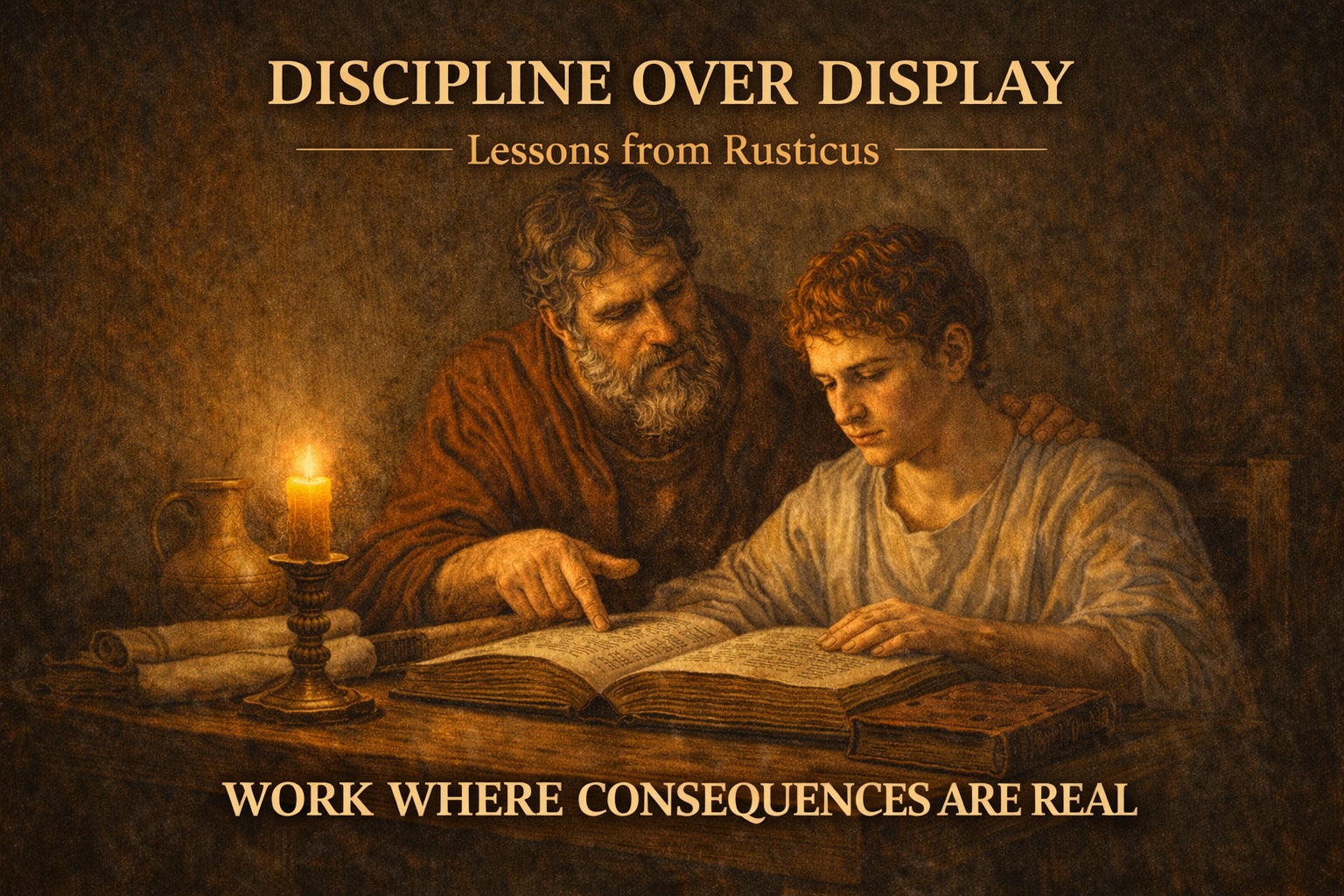
Lessons from Rusticus: Discipline Over Display
In Book I of Meditations, Marcus Aurelius thanks Rusticus for a kind of correction most of us avoid: a sober assessment that his character required improvement and discipline. The instruction is specific—avoid showing off, speak plainly, read deeply, reconcile quickly, and beware the seduction of rhetoric. It’s a compact operating manual for leaders who work where consequences are real.
Below are the practices I draw from this passage—applied to leadership, systems, and the modern tangle of technology and performance.
The Discipline of Not Performing
Rusticus warns against “sophistic emulation” and public benevolence for display. The modern forms are easier to miss:
-
Publishing thought without building anything that could fail
-
Refactoring a sentence instead of a system
-
Performing virtue or rigor in a status meeting while allowing ambiguity to multiply offstage
In a wheelhouse, a codebase, or a unit, performance is a liability. Noise grows. Decisions slow. Trust erodes. The alternative is a discipline of unimpressive, repeatable work—checklists, standard briefs, and logs that put outcomes over optics. Stoicism here isn’t an aesthetic; it’s an operating posture.
A simple test: if the camera were off and the credit anonymous, would you still do this?
Simplicity as a System
Marcus notes that Rusticus taught him to write letters with simplicity and to abstain from fine writing. Simplicity isn’t decoration; it’s a safety system. When words are clear, coordination tightens and errors surface early.
Try this across domains:
-
Design docs and orders: State mission, constraints, trade-offs, and decision criteria. Avoid slogans. Name the cost of saying yes.
-
Incident reports: Ban adjectives. Record facts, timelines, and hypotheses. Identify systemic causes, not culprits.
-
Emails and briefs: Lead with the request. Include the minimum context required to decide. Attach the appendix for those who need depth.
Clarity lowers variance. Teams move faster because decisions are legible.
Reconciliation as Operational Advantage
Marcus commends being easily pacified once an offender shows readiness to reconcile. That’s not sentimentality; it’s efficiency. Grudges are drag on an organization’s hull.
Mechanize reconciliation:
-
Time-box conflict: within 24 hours, move to a “repair brief.”
-
Use a shared fact set: what we know, what we believe, what we need next.
-
Separate accountability from resentment: enforce standards; drop theater.
-
Close with new rules of engagement: how we’ll operate to prevent a repeat.
Forgiveness is not forgetting. It is recommitting to execution with clear terms.
Read Deeply, Decide Deliberately
Rusticus taught Marcus to read carefully and not assent quickly to those who talk overmuch. In practice:
-
Read to build a model, not to extract quotes. What problem is the author solving? What assumptions must hold?
-
Annotate for disagreement. Where would this fail in your environment?
-
Delay assent. Sleep on high-cost decisions. If the argument relies on charisma, strip it down to premises and numbers.
In technology, verbose confidence often hides shallow reasoning. The same is true with intelligent systems. Modern AI can generate fluent answers that feel right while being wrong. Treat fluency as a red flag and insist on verifiability, provenance, and a clear decision pathway. Automation without understanding is fragile.
Guardrails Against Vanity
Marcus includes small corrections—don’t parade around the house in outdoor dress. Minor? Not really. It names a pattern: importing the theater of public identity into private work.
Practical guardrails:
-
No internal decks optimized for optics. “Pretty” loses to accurate.
-
Strip brand voice from operational documents. Plain English wins.
-
Measure what ships, not what trends. If vanity metrics rise while defect rates hold steady, you’re dressing up the house.
And regarding benevolence: do the work quietly. If it needs a camera, question the motive.
Choosing Your Sources
Marcus credits Rusticus for introducing Epictetus. It’s a reminder that curation is leadership. What you allow into your head shapes your moves under pressure.
Build a deliberate feed:
-
A short, rereadable canon: a few books that sharpen judgment
-
Technical papers that change how you model systems, not just add features
-
Case histories from domains with skin in the game—aviation, naval operations, engineering failures
Borrow standards from places where failure has consequences.
Practices to Operationalize Rusticus
If this passage were a checklist:
-
Before you publish: what utility does this create? What decision does it enable?
-
In briefs: lead with intent, constraints, options, and the decision rule. One page before appendices.
-
In meetings: ban performance. Define success, decide, assign owners, exit.
-
In reading: summarize the argument in five bullet points; list the failure modes.
-
In conflict: offer the first gesture of repair within 24 hours; document the new rule.
-
In AI use: require traceable sources, known error bounds, and human accountability. Treat eloquence as noise until verified.
-
In culture: reward correction given and received. Make it safe to be wrong and compulsory to learn.
Correction Over Flattery
Rusticus gave Marcus the gift of disciplined criticism—an antidote to vanity and a safeguard against intellectual excess. The habits he taught still govern durable systems: speak plainly, reconcile quickly, study deeply, and refuse to confuse performance with substance. Leadership begins where applause stops and responsibility starts.
If you’re building in environments where decisions carry weight, these standards hold. They are not flashy. They compound.
If this perspective helps you navigate complexity with more clarity and less noise, subscribe to The Rissler Perspective for future essays and field-tested practices.