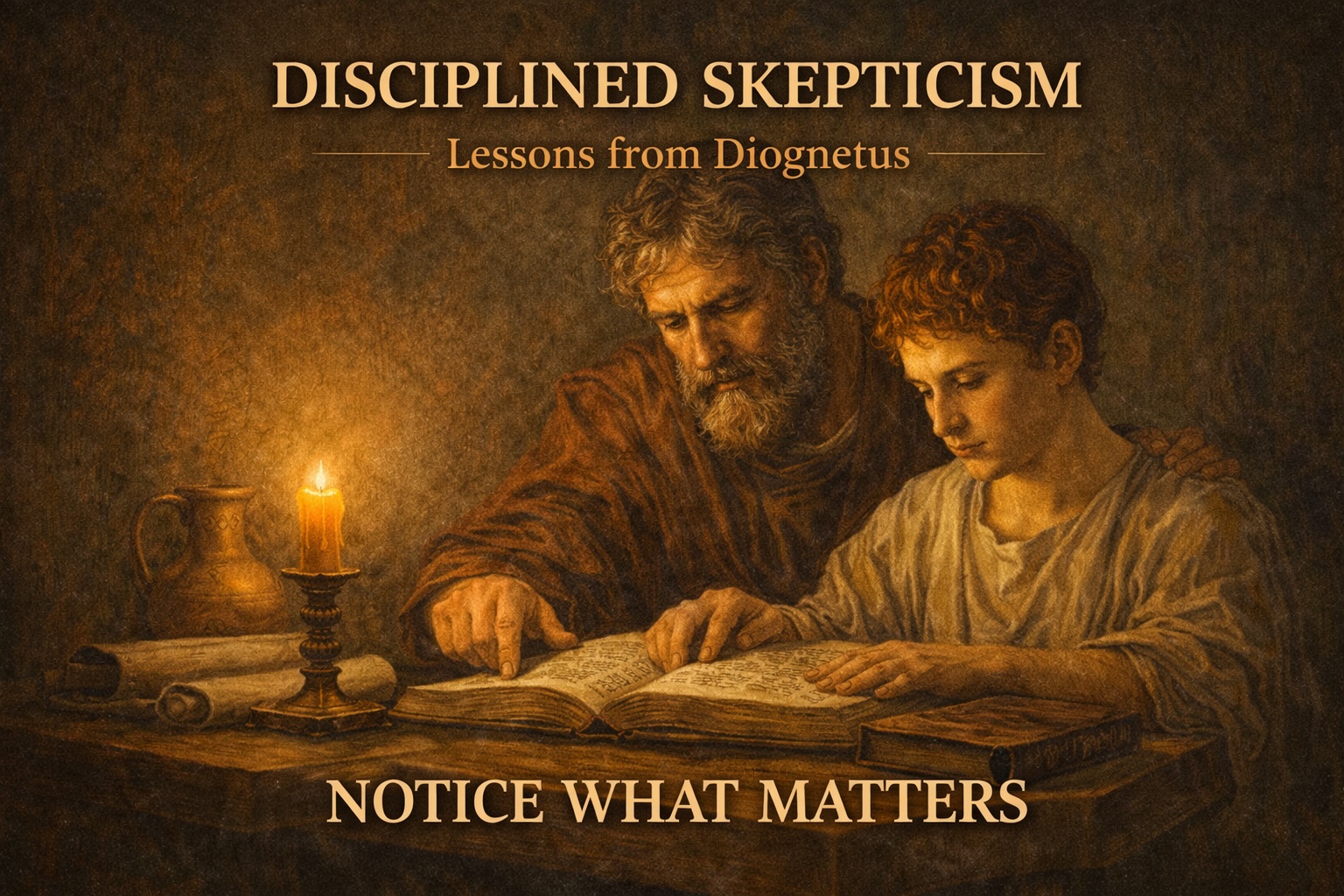
Diognetus and the Discipline of Noticing What Matters
Diognetus sits early in Marcus Aurelius’ ledger of debts—an understated mentor who, by Marcus’s account, redirected a young heir from spectacle toward substance. We know little about the man beyond this brief acknowledgment, but the imprint is clear: skepticism over superstition, plain living over excess, and an introduction to philosophy as something practiced, not performed. In the economy of influence, Diognetus invested small, precise habits that compounded into a governing mindset.
What Marcus Learned in Book I, Section 6
In this short passage, Marcus credits Diognetus with several linked disciplines:
-
Resist trifles—avoid letting small amusements consume attention.
-
Distrust miracle-workers and theatrical claims.
-
Endure frank speech without defensiveness.
-
Become intimate with philosophy through teachers and writing.
-
Embrace voluntary simplicity—the “plank bed and skin” of Greek training.
Together they form a bias for rational inquiry and disciplined living. This isn’t philosophy as ornament; it is a pattern of choices that curbs impulse, clarifies judgment, and builds a life that can carry weight.
Against Trifles: The Cost of Small Distractions
“Not to busy myself about trifling things” sounds quaint until you audit a week honestly. In modern leadership and technical work, the trifles are subtler:
-
Vanity metrics and dashboards that signal activity, not outcomes.
-
Meetings that preserve status rituals while decisions stall.
-
Inbox triage masquerading as progress.
-
Optimization games—tuning what is easy to tune while core risks go untouched.
Systems shape behavior. If a system rewards responsiveness over reflection, you will produce noise. If it treats every input as urgent, your best thinking will never arrive. Diognetus’s advice reads like an operating rule: set thresholds, create buffers, and preserve time for slow, consequential work. The discipline is less about austerity and more about protecting the conditions where judgment can form.
Against Incantations: Superstition in a Technical Age
Marcus was told to distrust “miracle-workers and jugglers.” We have our own versions:
-
Cargo-cult processes: adopting stand-ups, OKRs, or “AI transformation” without the corresponding accountability.
-
Metric theater: treating model accuracy, uptime, or engagement as proof of value while ignoring context or consequence.
-
Tool worship: believing a platform will solve a leadership problem.
In engineering and operations, incantations look like ritualized language that replaces investigation. In leadership, they look like slogans that absolve us from owning trade-offs. The remedy is not cynicism but testable claims: define what success would look like, decide how you’ll know, and commit to changing course when reality disagrees.
AI as Tool, Not Oracle
AI sharpens this temptation. It offers confident text, quick classifications, and the feeling of progress. Used well, it compresses time-to-insight and reduces toil. Used as an oracle, it breeds fragile systems.
Practical guardrails:
-
Treat outputs as hypotheses to be checked, not facts to be believed.
-
Constrain scope: deploy AI where the cost of error is low or recovery is fast.
-
Preserve provenance: log prompts, decisions, and human overrides.
-
Keep human accountability explicit—someone owns the outcome, not the model.
Automation without understanding is brittle. Understanding without context is incomplete. Align the tool to a purpose you are prepared to defend.
Freedom of Speech and the Weight of Candor
“Endure freedom of speech” is a leadership test. It is easy to ask for candor and punish it in practice. In high-stakes environments—bridge, boardroom, or incident call—freedom of speech means:
-
Separating threat from feedback.
-
Deliberately inviting disconfirming views before locking a plan.
-
Rewarding clear dissent that improves the decision, even when it slows momentum.
Candor is not noise if it changes your action. Build the muscle memory: pre-brief where dissent belongs, record what changed, and close the loop with gratitude. Over time, the system teaches people that truth beats theater.
Philosophy as Training: Teachers, Writing, and Voluntary Constraints
Marcus credits teachers by name and notes he wrote dialogues in youth. The lesson is method:
-
Apprenticeship: borrow judgment from those who have carried real consequences. Learn their failure modes, not just their maxims.
-
Writing to think: externalize reasoning, expose gaps, and make trade-offs explicit. Good writing encodes decision quality.
-
Voluntary discomfort: the “plank bed and skin” isn’t heroics; it’s controlled friction that tunes attention. In modern terms: constraints on spending, simplicity in gear, disciplined routines that reduce choice clutter.
These practices don’t signal virtue; they stabilize execution. When pressure arrives, you won’t rise to the occasion—you’ll default to your training.
The Diognetus Checklist for Leaders and Builders
Use this as a weekly audit:
-
What are this week’s trifles? Remove one ritual, metric, or meeting that preserves image over impact.
-
Which claim am I accepting on authority alone? Define a falsifiable check and run it.
-
Where is candor unsafe in my team? Set a pre-brief for dissent and make one visible decision change because of it.
-
What will I write to clarify a live uncertainty? One page, circulated for critique.
-
What constraint will I adopt for seven days? Timebox, budget cap, or a deliberate reduction of inputs to recover focus.
-
Where can AI reduce toil without outsourcing judgment? Pilot in a reversible, low-risk slice; log outcomes.
Small, repeatable moves beat occasional heroics.
Durable Orientation in a Noisy World
Diognetus gave Marcus early exposure to philosophy and skepticism—skills for triage under uncertainty. Stoic resistance to superstition is not anti-wonder; it is pro-reality. Disciplined living is not deprivation; it is alignment with purpose. When stakes are real, clarity is an act of responsibility, not style.
The work is not to become unshakeable; it is to become reliable—capable of making and owning decisions when theory is silent and consequences are near. That is where philosophy stops being abstract and starts becoming a craft.
If this perspective resonates, subscribe to The Rissler Perspective for future essays on leadership, systems, and the disciplined use of technology.