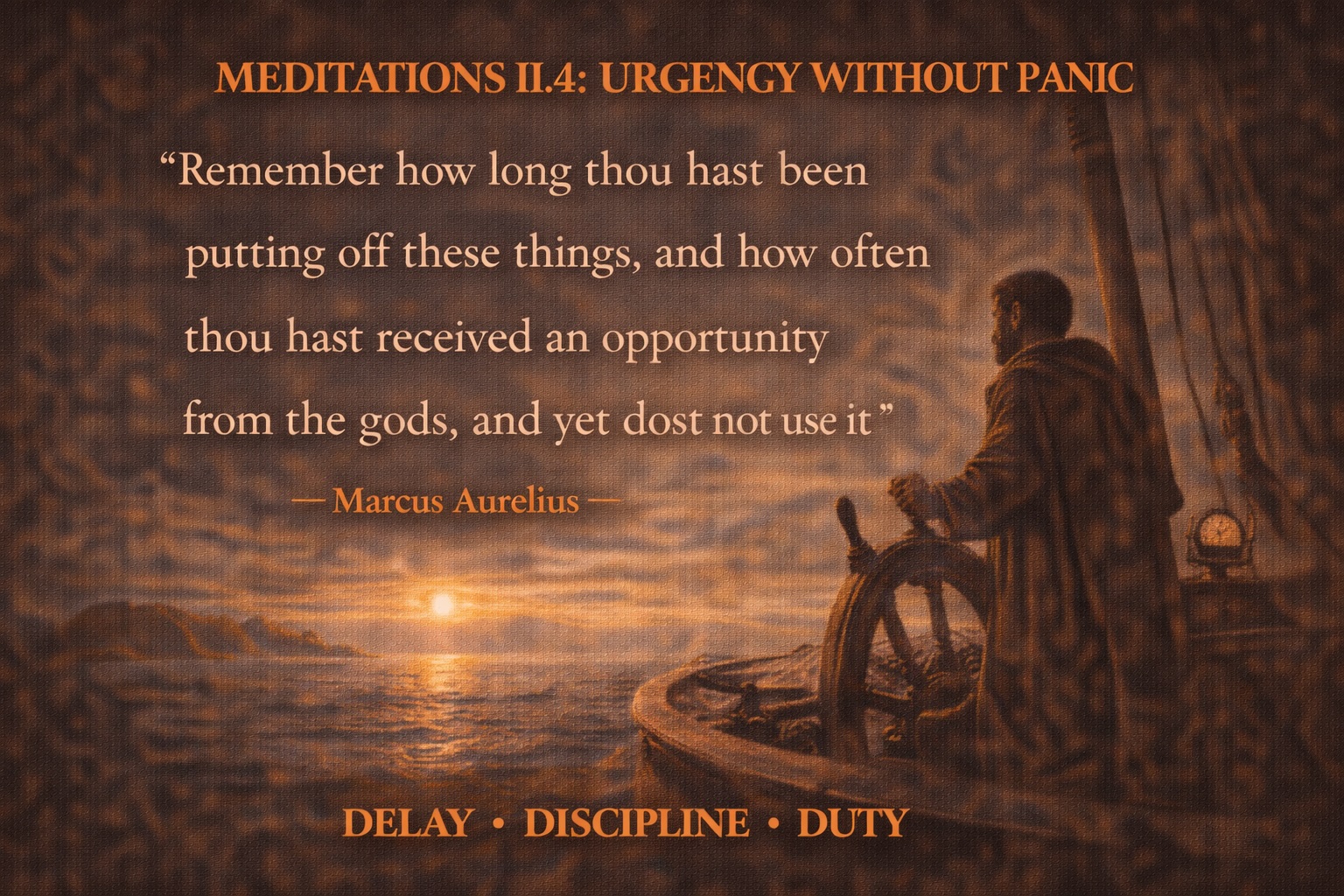
Meditations II.4: Urgency Without Panic
“Remember how long thou hast been putting off these things, and how often thou hast received an opportunity from the gods, and yet dost not use it.”
Marcus Aurelius does not scold here; he audits. Delay is not just a habit—it is a system property, a drift we either counter by design or surrender to by neglect. In Stoicism, time is finite and discipline is immediate. The work is moral action now, not later. In practice, this is less about speed than about setting clear thresholds where hesitation ends and duty begins.
The cost of delay is not just time
In real environments—ship bridges, production systems, small teams under pressure—procrastination compounds:
-
Decision debt: Unmade calls accumulate interest. Options narrow. The eventual decision, when forced, is worse and more expensive.
-
Information decay: Signals go stale. Assumptions age. Yesterday’s data misleads today’s choice.
-
Behavioral drift: Teams imitate tolerated delays. Standards slide quietly, then suddenly.
-
Latent risk: Small anomalies metastasize. A minor leak becomes structural; a minor exception becomes precedent.
Urgency in moral action is not a sprint. It is a commitment to collapse avoidable latency—between noticing and owning, between knowing and doing.
Opportunity windows in real systems
Leaders don’t manage time abstractly; they manage windows.
-
Software architecture: A small security patch deferred becomes a weekend incident with legal exposure. The window to fix with minimal blast radius closes quickly.
-
Maritime operations: Weather windows are not metaphors. You either depart on the tide or you accept a different risk profile, perhaps for days. Maintenance is similar: address a suspect hose at the dock, or address the flooding offshore.
-
Organizations: Feedback carries the highest signal closest to the event. A quiet correction now preserves dignity and culture. A delayed intervention becomes an HR case study.
Treat windows as design constraints, not surprises. Build practices to see them and act while they are open.
Turning urgency into practice
Theory breaks under load. Systems hold.
Define “immediate acts”
Pre-decide categories of work that are never deferred:
-
Safety corrections
-
Ethical violations and conflicts of interest
-
Security patches with known exploits
-
Clear commitments owed to others
-
Two-minute fixes that unblock others
If it prevents harm, protects trust, closes a known vulnerability, or keeps a promise, it moves now. No meetings. No stack-rank.
Set action thresholds
Ambiguity invites delay. Thresholds create consistent behavior:
-
Time thresholds: “If a decision will be clearer in 24 hours, wait; if not, decide before close of business.”
-
Risk thresholds: “If the downside is limited and reversible, act. If irreversible, escalate and slow down.”
-
Ownership thresholds: “If it’s in your lane and the cost of a wrong move is low, take it. Don’t forward responsibility by default.”
Thresholds convert values into operations.
Use latency budgets
Architects budget CPU and network latency; leaders can budget decision latency. For repeated actions—hiring responses, incident triage, customer escalations—set maximum allowable delay and instrument it. If the budget is exceeded, treat it as a defect in the system, not a personal failing. Fix the path, not the person.
Establish standing orders
Clarity survives fatigue. Examples:
-
“Restore safety first, then diagnose.”
-
“Default to least privilege; add access as needed.”
-
“If one honest voice says ‘unsafe,’ stop.”
-
“Document a decision in one paragraph before you broadcast it.”
Standing orders shorten the distance between recognition and action when pressure is high.
Close loops visibly
Every open loop drains attention. Close them in view of those affected:
-
Acknowledge receipt with a time to resolution.
-
Deliver or renegotiate, then log the change.
-
Record why you chose now versus later.
Visible closure builds trust and reduces the organizational temptation to defer.
Discipline without haste
Stoicism is not hustle. The aim is unhurried precision under constraints. That means:
-
Refusing false urgency. Not everything is “now.” Protect deep work and sleep with the same rigor you bring to incidents.
-
Choosing the scale of action carefully. The smallest adequate move today beats the perfect solution “soon.”
-
Accepting fewer commitments. Procrastination hides overcommitment. Reduce inputs and your system stabilizes.
Urgency should be earned by consequence, not by culture.
Where AI fits—and where it doesn’t
Intelligent tools should compress friction, not judgment.
-
Good uses: Drafting a first pass to shorten the “blank page” delay; summarizing logs; surfacing anomalies; testing edge cases; stress-testing reasoning with counterarguments.
-
Bad uses: Deferring accountability to a model; outsourcing ethical calls; generating noise that creates more loops to close.
Set boundaries: humans own intent, ethics, and final calls. Use AI to accelerate the mechanics so moral action happens while the window is open.
A simple daily drill
-
Identify one avoided action with real consequence.
-
Define the smallest adequate move. Five minutes, not five hours.
-
Do it before noon. Log what changed.
-
Note the cause of the prior delay: ambiguity, fear, overload, missing data, unclear ownership.
-
Adjust the system—add a standing order, threshold, or budget—so the next instance moves sooner.
Compounded over months, this turns urgency from a feeling into an operating model.
Leadership is the end of excuses
On a bridge at night, no one cares why you delayed the course correction. In a data breach, no one rewards your intention to patch. In a team under strain, your delay teaches others what is acceptable. Leadership under uncertainty is not perfection; it is disciplined willingness to act before hindsight. Marcus’s reminder is not a reprimand but a directive: close the gap between knowing and doing, while the window is open and your agency is real.
If this perspective is useful, subscribe to The Rissler Perspective for future essays on leadership, systems, and disciplined judgment.