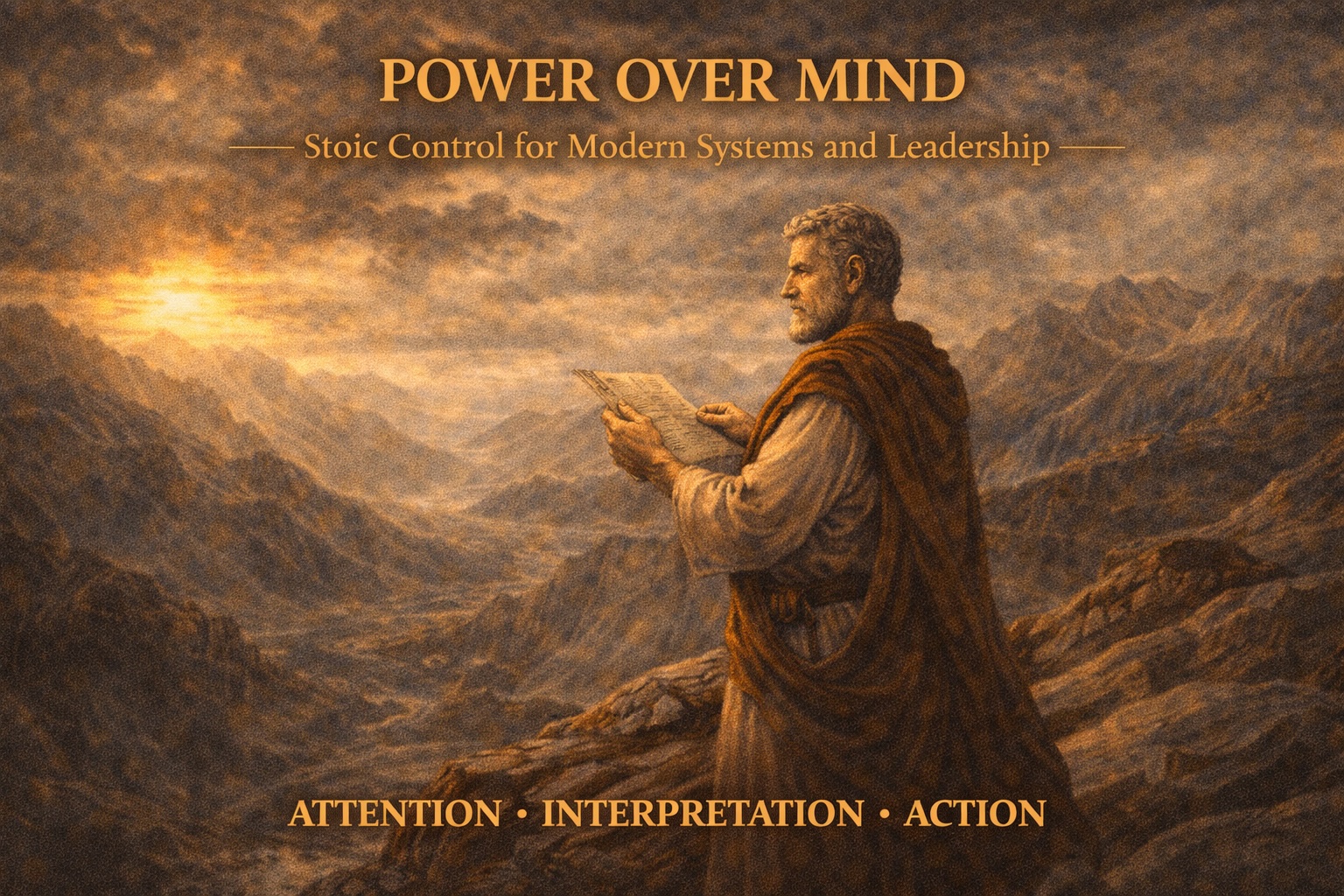
Power Over Mind: Stoic Control for Modern Systems and Leadership
“Thou hast power over thy mind — not outside events.” This line is simple enough to tattoo, but it isn’t a slogan. It’s a boundary condition. In engineering, seamanship, or command, boundaries are where reality speaks plainly. This one says: attention, interpretation, and choice are ours. Weather, markets, and other people are not. Mastery begins and ends with judgment.
Control as a Design Constraint
Stoic control is not passivity. It is the discipline to distinguish:
-
What is mine to govern: perception, standards, commitments, actions.
-
What is not: outcomes, timing, external shocks, others’ responses.
Good systems start with the same separation. We define control surfaces and accept load that exceeds them will spill somewhere. The design question becomes: where does it spill, and how do we fail without losing integrity?
In leadership, this looks like shaping the conditions for sound decisions rather than managing every variable. Control becomes architecture, not theater.
Three Arenas Where the Boundary Matters
On the bridge in a squall
Wind, current, engine lag — not in your control. Scan rate, throttles, helm, crew coordination, abort criteria — fully yours. Judgment is choosing to reduce sail early, assign clear roles, and call a go/no-go based on set points, not hope. The squall is indifferent. Your mind draws the line between seamanship and salvage.
In a production outage
The bug is already live. Timelines, customer complaints, and executive pressure sit outside. Inside: incident roles, discipline, hypotheses, rollback plan, a single source of truth. The team’s attention is the scarce resource. Own it, or the event will own you.
In a boardroom
Markets pivot. Competitors undercut. Investors want certainty. None of that is yours. The controllables: narrative clarity, assumptions laid bare, decision criteria agreed in advance, and the courage to say “we don’t know yet — here’s how we’ll find out.” Strategy is choice under constraint, not wishful arithmetic.
Judgment as the Core Skill
If control is the boundary, judgment is the mechanism. It involves:
-
Framing: naming the actual problem before acting.
-
Prioritization: deciding what to care about first, and what to ignore.
-
Timing: acting neither too early (thrashing) nor too late (escalation).
-
Standards: pre-committing to thresholds that trigger action.
-
Accountability: owning consequences without outsourcing blame.
Judgment grows through repetitions under real stakes. It is trained, not proclaimed.
What You Control (and What You Don’t)
Within control:
-
Attention: what signals you amplify or discard.
-
Interpretation: separating observation from story.
-
Action: the next deliberate move, however small.
-
Process: checklists, comms patterns, escalation paths.
-
Character: the tone you set when pressure is high.
Outside control:
-
Weather, time, and entropy.
-
Others’ choices and emotions.
-
Randomness and tail events.
-
Immediate public perception.
Confusing these is costly. Treating externals as controllable breeds magical thinking. Treating internals as fixed breeds fatalism. Both erode judgment.
Tools That Move the Needle
We cannot command outcomes, but we can enlarge the sphere where judgment reliably produces good results. Practical tools:
-
Pre-decisions: Define abort criteria, margins, and red lines when calm. Make the hard choice easy later.
-
Checklists and briefs: Not as bureaucracy, but as memory aids that conserve attention.
-
Instrumentation: Measure leading indicators. You can’t steer by vibes.
-
Slack: Capacity buffers in crews, schedules, and systems. Tight coupling without slack is a control illusion.
-
Drills: Rehearse failure modes so first exposure isn’t live.
-
After-action reviews: Non-punitive, brutally honest. Turn events into improvements.
-
Single-threaded ownership during crises: One coordinator, clear channels.
-
Default-off for irreversible moves: Require friction before committing to actions that can’t be undone.
Each tool protects the mind from being captured by the event.
AI as Watchstander, Not Captain
Intelligent systems can sharpen perception and reduce noise, but they have no skin in the game. They should:
-
Surface alternatives and stress-test assumptions.
-
Accelerate pattern recognition and scenario generation.
-
Log decisions and rationale for later review.
They should not:
-
Hold authority over commitments or values.
-
Bypass human-defined criteria for risk.
-
Own accountability.
Treat AI like a skilled watchstander: trusted to advise, never to decide. The boundary of control remains human judgment, ethics, and intent.
Failure Modes When We Cross the Boundary
-
Command theater: Constant announcements and dashboards in place of decisions. Looks like control; isn’t.
-
Outcome worship: Redefining success post hoc to avoid admitting error. Destroys learning.
-
Blame shifting: Externalizing responsibility when risks were chosen internally.
-
Panic automation: Gluing scripts to unknowns, creating fragile speed.
-
Cynical resignation: “Nothing is controllable,” which is a convenient escape from standards.
The antidote is simple, not easy: return to the controllable, adjust, and recommit.
Training the Mind Under Constraint
Mastery of judgment is cultivated daily:
-
Morning framing: What is mine today? What is not? Write it down.
-
One decision at a time: Reduce scope until a clear next action appears.
-
Language discipline: Replace “made me” with “I chose.” Accuracy builds agency.
-
Exposure: Seek controlled stress — drills, red teams, cold starts.
-
Quiet: Protect blocks of undistracted time. Attention is your primary instrument.
This is not self-help. It is maintenance. Hulls foul. Minds drift. Clean both on a schedule.
Closing the Loop
“Power over thy mind” is not comfort. It’s responsibility. On the bridge, in the incident channel, at the table — the world will remain noisy, uneven, and occasionally unfair. Good. That keeps us honest. Control the controllable, design for the uncontrollable, and let judgment do its work.
If this perspective resonates, subscribe to The Rissler Perspective for future field notes on judgment, systems, and leadership under real conditions.