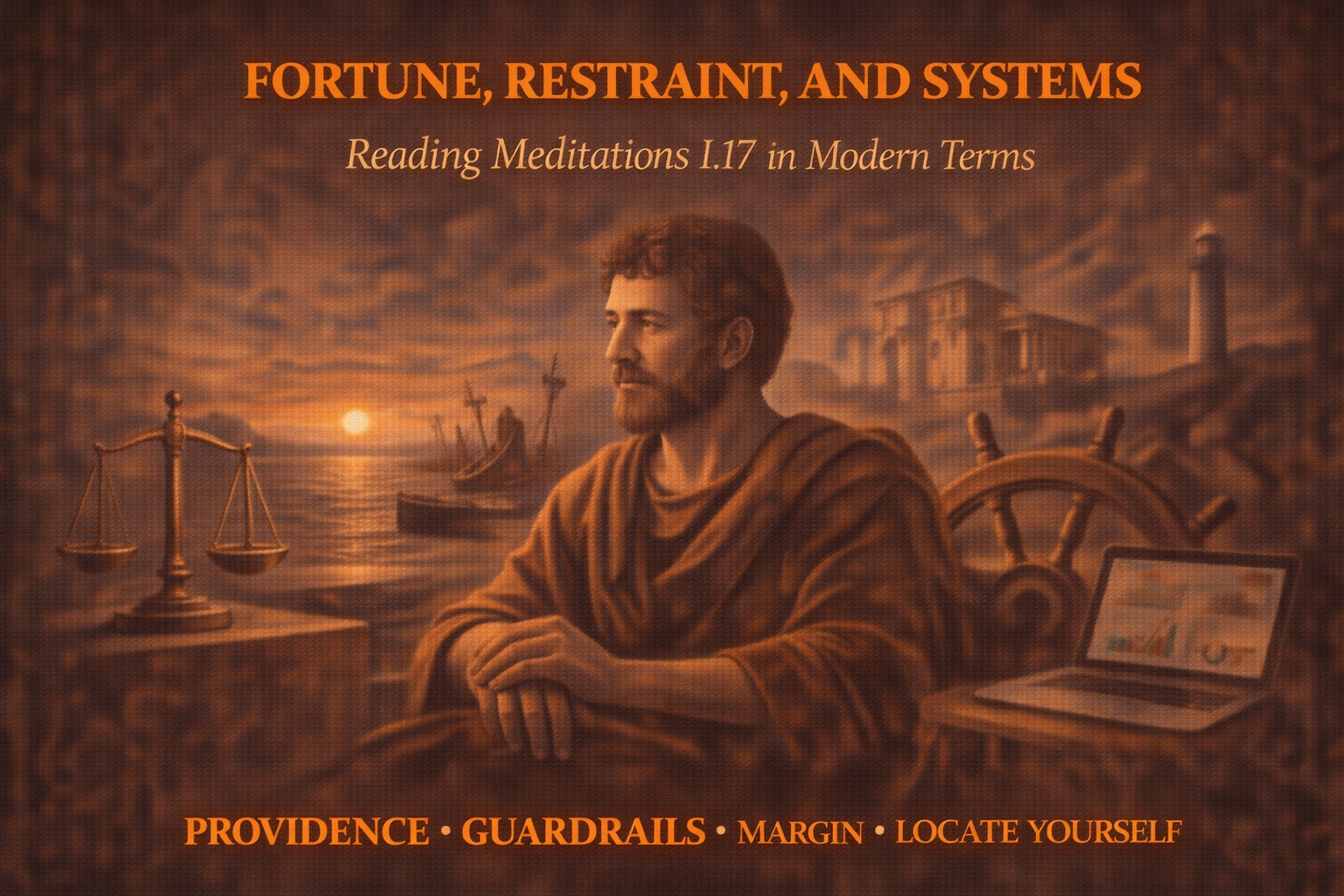
Fortune, Restraint, and Systems: Reading Meditations I.17 in Modern Terms
Book I of Meditations ends with an inventory of debts. Marcus Aurelius names the people who shaped him and then widens the lens to fortune itself: the “concurrence of circumstances” that spared him certain tests, moderated his appetites, and kept him close to ordinary life even in a palace. It reads like a leader acknowledging not just mentors and habits, but context—how the system around him constrained failure and amplified discipline.
For anyone operating under real constraints—commanding a crew, running a company, shipping software, guiding an organization—the passage is more than piety. It’s a blueprint for responsible agency inside complex systems.
Gratitude as Operational Realism
Gratitude here is not sentiment; it’s a clear-eyed audit of causal factors.
-
Good family and teachers created defaults that reduced friction toward the good.
-
A brother’s character acted as constant calibration.
-
Health, spared temptations, and timely restraints lowered the probability of doing damage.
He is honest about counterfactuals: in different conditions, he might have failed. That humility is practical. It keeps you from overfitting your story to personal virtue and underestimating luck, timing, or structure. Leaders who ignore this drift into survivor bias; systems then break when luck runs out.
Agency Meets Circumstance: Where Control Actually Lives
The passage frames moral development as a collaboration: discipline plus environment. In modern terms, it’s a question of control surfaces.
-
What is within your deliberate practice: judgment, restraint, preparation.
-
What is shaped by the system: incentives, constraints, culture, timing.
-
What remains stochastic: weather, markets, opaque dependencies.
Competence grows fastest when you align practice with system design. You don’t eliminate chance; you narrow the paths where chance can cascade into failure.
Designing Around Failure, Not Just Aspiring to Virtue
Marcus credits “favour” for never meeting a perfect storm of temptation and opportunity. Sensible leaders don’t wait for that convergence to measure their character; they design so the convergence is unlikely, noticeable, and containable.
-
Maritime: A captain who never faced a true gale isn’t superior—he chose weather windows, kept margin, and avoided heroics. Redundancy, drills, and fuel reserves are moral choices expressed as engineering.
-
Software: If the race condition never bit in production, don’t mistake luck for design. Build observability, rate limits, circuit breakers, and blunt edges where human error is most likely.
-
Organizations: Rotate duties, split authorities, and define thresholds that require a second set of eyes. Structure turns private virtue into public safety.
Restraint is more credible when it is embedded in process, not just asserted in character.
Power Without Ornament
Marcus learned it is possible to live “in a palace” without guards and show. Translate that to modern leadership: avoid theater. Status signaling, constant entourage, and performative busyness add noise and distort feedback. The work benefits from quiet power:
-
Minimal ceremony around decision-making.
-
Direct access for those closest to the edge of the system.
-
Budgets and tools chosen for function, not optics.
A leader who looks like a private person may still act with full authority; the difference is that the organization’s attention stays on outcomes, not on the leader’s performance.
Counterfactual Humility: Accounting for the Trials You Didn’t Face
Aurelius thanks fortune for near-misses: not being pushed beyond his limits at the wrong time. Modern equivalents are everywhere:
-
The deal that fell through and saved you from an ugly counterparty.
-
The untested backup that was never called on.
-
The junior teammate who wasn’t left alone during an emergency because the schedule slipped.
Treat these as signals. Conduct near-miss reviews with the same rigor as postmortems. Ask, “What would have happened if the timing were worse?” Then turn gratitude into design change.
Teachers, Associates, and the System of Influence
He credits not falling into sophistry or rhetorical games. You become what your incentives and reading lists reward. Choose inputs that train judgment, not vanity.
-
Encourage apprenticeship over rote credentialing.
-
Reward clarity over cleverness in documents and reviews.
-
Measure narrative quality by decisions improved, not attention captured.
What you praise, publish, and promote becomes the culture’s gradient.
Providence, Guardrails, and AI
If “providence” reads archaic, think defaults, guardrails, and fail-safes. Intelligent systems can extend good judgment—or scale bad judgment faster.
-
Keep humans in the loop where intent, ethics, or ambiguity dominate.
-
Bound automated actions with clear limits, logging, and rollback plans.
-
Treat model outputs as hypotheses to be tested against reality, not authorities to obey.
Automation without understanding is fragile. Use AI to sharpen thinking, reduce noise, and increase your surface area for learning—never to abdicate responsibility.
Practices: Operationalizing Stoic Gratitude
Turn the sentiment of I.17 into routines that change behavior.
-
Daily debt audit: Note one outcome that went well due to others or conditions, and one design change that makes success less accidental.
-
Pre-mortems: Before major actions, list the temptations and shortcuts most likely to appear under pressure; add friction ahead of time.
-
Near-miss reviews: Treat “we got lucky” as a failure class. Capture it. Fix it.
-
Status minimalism: Remove one ornamental process or perk that clouds information flow.
-
Apprenticeship lanes: Pair rising leaders with steady hands; let character be learned by proximity, not slogans.
-
Margin by default: Extra time, fuel, cash, and observability are moral instruments. Protect them.
Closing the Inventory
Marcus finishes Book I by locating himself inside a web of causes and constraints. That perspective does not diminish agency; it disciplines it. The leader who understands the system that carries him—people, processes, luck, and limits—can act with firmness and humility. He can live “near the fashion of a private person,” focused on the work, grateful without self-congratulation, and prepared for the day when fortune no longer shields him.
If this exploration resonates, subscribe to The Rissler Perspective to continue the conversation on leadership, systems, and judgment under real constraints.