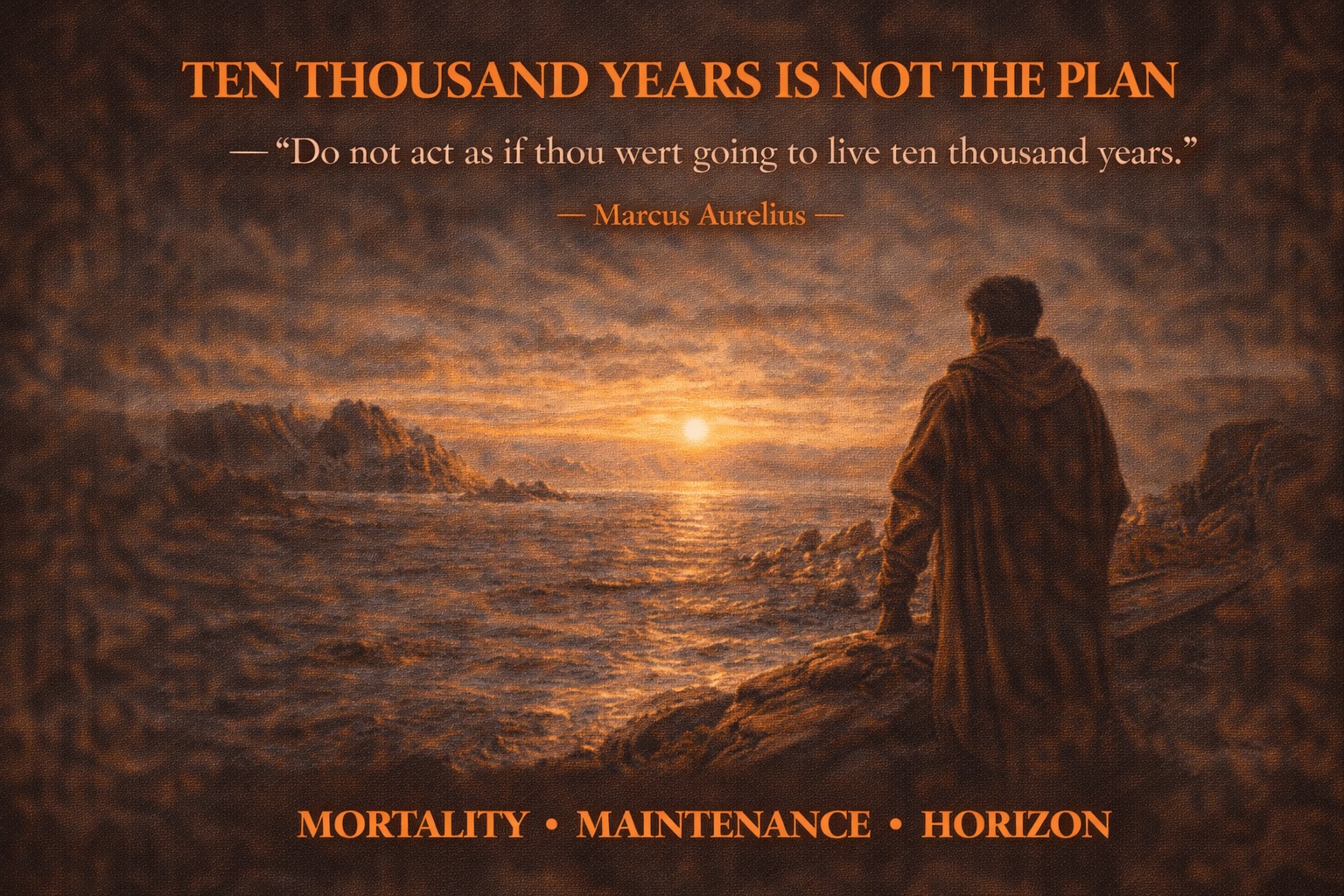
Ten Thousand Years Is Not the Plan
“Do not act as if thou wert going to live ten thousand years.” Marcus Aurelius wasn’t urging speed. He was restoring proportion. Mortality is not a mood; it’s a design constraint. When you accept that constraint, attention sharpens, excuses thin out, and our lives move toward what actually matters.
Stoicism uses impermanence to align action with responsibility. In leadership, engineering, and seamanship, the clock is not abstract. Weather windows close. Systems drift without maintenance. Teams adopt the habits you tolerate. The reminder is simple: you don’t have forever to make things clear, resilient, or right.
Mortality as a Design Constraint
The ship leaves the dock with the tools, fuel, and judgment you actually have. You cannot borrow an extra year of calm seas. That reality changes how you plan:
-
You bias to essentials. Critical path, not comfort features.
-
You balance redundancy with weight. Spares that matter, not spares that soothe.
-
You verify under load. The only tests that count resemble the conditions you’ll face.
Organizations operate the same way. Strategy written as if time were infinite becomes theater. Teams feel the difference between a leader counting quarters and a leader acting as if there will always be another rewrite. Mortality forces architecture to be honest: coherent boundaries, clear interfaces, and a maintenance budget that survives the quarterly review.
The Horizon You Choose Shapes the System You Build
There’s a trap in thinking “don’t act as if you have ten thousand years” means “work faster.” Speed without direction burns options. The correction is horizon discipline:
-
Short horizon (hours to weeks): execute, close loops, remove single points of failure.
-
Medium horizon (quarters): shape capacity, repay principal on tech debt, train replacements.
-
Long horizon (years): define standards, values, and compounding mechanisms.
Leadership means deciding which horizon today deserves your full attention—and protecting it from the others. A captain in a tight inlet does not discuss five-year refit plans. A CTO in a calm quarter must not behave like it’s an incident bridge. Mortality reminds you to match your posture to the real horizon, not the one that flatters your identity.
Decision-Making When Time Is Not Guaranteed
Operating under limited time changes the math of decisions.
-
Reversible vs. Irreversible: Push reversible decisions down and make them quickly. Slow down for one-way doors. Use checklists and dissent intentionally.
-
Satisficing vs. Optimizing: “Good enough, now” beats “perfect, later” when delay magnifies risk. Optimize only where compounding returns justify it.
-
Latency to Action: Measure the delay between recognizing a risk and taking the first corrective step. Lower latency is often more protective than higher precision.
On a night watch, a half-degree course correction early beats a hard rudder turn later. In a scaling system, setting a clear deprecation date beats waiting for universal alignment. Mortality favors early, modest course corrections over late heroics.
Maintenance Is Moral, Not Mundane
We admire building more than maintaining. That’s vanity. The ship that “almost worked” is dangerous. The codebase that “mostly passes CI” is debt. The team that moves fast by skipping after-action reviews is learning the wrong lessons.
Treat maintenance as a standing obligation:
-
Protect maintenance windows. Put them on the calendar and defend them in public.
-
Audit for drift. Systems and cultures move toward entropy; measure and reset.
-
Close feedback loops. Logbooks, postmortems, customer calls—look for friction you’ve normalized.
-
Train on the boring drills. Emergencies expose whether fundamentals are alive or ceremonial.
Impermanence makes maintenance non-negotiable. You may not get another calm day to re-pack that stuffing box—or to rework that brittle core service everyone quietly fears touching.
Saying the Necessary Thing
Finite time clarifies conversations. Leaders buy themselves trouble by postponing the hard words: “We’re stopping this project.” “Your role changes now.” “We shipped complexity we can’t defend.”
A useful practice:
-
Name the risk publicly.
-
State the decision and the rationale.
-
Own the consequence window (what changes in the next day, week, and quarter).
-
Invite correction on your premises, not your character.
Memento mori is not morbidity. It is the courage to be plain when plainness is kinder than delay.
Tools, AI, and the Temptation to Defer Judgment
AI and automation can compress cycles and surface signal. They do not extend your lifespan, and they should not extend your cowardice. Use them to reduce latency, not to avoid responsibility.
-
Employ AI to draft options, simulate failure modes, and stress-test assumptions.
-
Keep humans accountable for intent, boundaries, and escalation criteria.
-
Don’t automate what you don’t understand. Fragility hides in borrowed abstractions.
Technology is an amplifier. If you are unclear, it multiplies noise. If you are clear, it multiplies reach.
A Practice for Finite Lives
Not hacks—habits that respect the clock:
-
Morning: Identify the one decision you’re most likely to avoid. Make it first.
-
Midday: Close one loop you’ve left open too long—a call, a fix, an apology.
-
Evening: Write three lines in the log: what mattered, what failed, what you’ll change tomorrow.
-
Weekly: Retire an obligation that no longer fits your horizon.
-
Quarterly: Rehearse a failure you hope never arrives.
The point isn’t to feel urgent. The point is to live proportionally: fewer, better commitments; clearer interfaces; steadier hands.
The Weight of the Reminder
“Do not act as if thou wert going to live ten thousand years” is not a productivity slogan. It’s an invitation to integrate your values with your calendar, your architecture, your crew. Accepting impermanence is not despair. It is discipline. It curbs performative work, prioritizes maintenance, speeds reversible choices, and brings speech and action into alignment.
The ship is under way. Act accordingly.
If this perspective helps you navigate complexity with steadier judgment, subscribe to The Rissler Perspective for future wisdom and field notes.