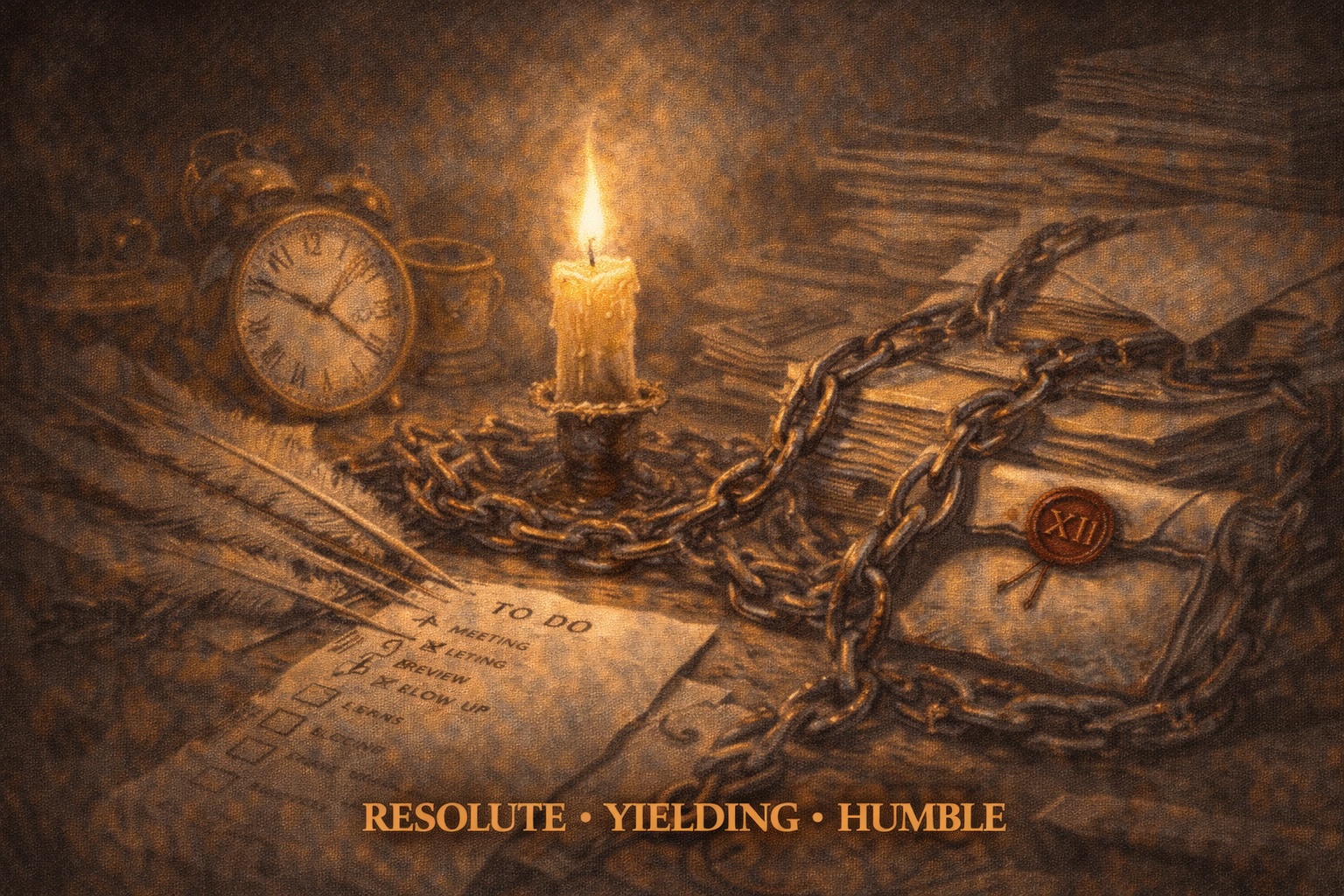
Stop Saying “No Leisure”: Duty Under Load — Meditations I.12 in Practice
Marcus Aurelius’ note in Meditations I.12 is simple and merciless: don’t make a habit of saying “I have no leisure,” and don’t use busyness to excuse neglecting the duties you owe to the people around you. In Stoic leadership, duty is not suspended by busyness. Self-command includes honoring obligations without complaint or self-importance.
This is not about politeness. It is about integrity under load.
The Modern Form of “I Have No Leisure”
Today the phrase shows up as “no bandwidth,” “swamped,” or “heads down.” Often it’s true. But repetition turns a fact into a posture. It communicates that your work is more real than other people’s needs, and it shifts the cost of your priorities onto them.
Patterns to watch:
-
Habitual apology: “Sorry for the delay, things are crazy here.”
-
Status signaling: busyness used as proof of importance.
-
Relationship drift: recurring neglect of 1:1s, reviews, or basic courtesies.
In systems terms, “no leisure” is an unhandled interrupt. If it’s constant, it’s a design flaw.
Duty as a Design Constraint
Leadership, like engineering and seamanship, is bounded by non-negotiables. On a boat you don’t tell a bilge alarm you’re too busy; you respond. In software architecture, you don’t defer critical security patches because quarterly goals are “urgent.” In a unit, you don’t skip the watch because the briefing ran long.
Treat human obligations as first-class loads in the system, not optional features. Build for them.
Practical design constraints:
-
Standing checks: regular 1:1s, code reviews, maintenance rounds. Schedule them, protect them.
-
Response thresholds: decide what gets same-day attention and what can wait, then honor it.
-
Capacity limits: reduce work-in-progress so you can respond without cascading failure.
-
Boundaries: clear on/off duty windows so people know when you’re reliably reachable.
When obligations are built into the cadence, you don’t need to borrow against the future with excuses.
Self-Command Without Theater
The Stoic point is not martyrdom. It’s restraint. No complaint, no performative sacrifice, no self-importance.
Try three small disciplines:
-
Plain speech: replace vague apology with a clear statement. “I can’t meet Thursday; I can meet Monday at 1500.”
-
Quiet follow-through: no fanfare around doing the basics—showing up prepared, on time, and attentive.
-
Debrief your misses: when you fail a duty, fix the system, not just the moment.
Self-command is visible in how you carry routine burdens, not in how loudly you carry them.
Routines That Prevent Apology
Systems reduce the need for explanation. A few low-drama routines help.
-
Obligations ledger: track commitments to people, not just tasks—promises, decisions owed, feedback dates. Review it daily.
-
Fixed maintenance windows: reserve time for essential but non-urgent duties (reviews, mentoring, inspection, documentation).
-
Triage rules: two-minute responses for quick acknowledgments, next-business-day for substantive replies, with expectations set in advance.
-
Default alternatives: offer a counter-proposal when you say no—“not this week; I can do a 20-minute call Tuesday at 0900 or write a summary by EOD.”
-
Closing loops: never let a request die quietly. If the answer is no, say no cleanly.
Each removes friction without outsourcing judgment.
Saying No, Cleanly
Busy is not an alibi. When you must decline, do it without evasion.
Better phrases:
-
“I won’t be able to take this on. If deadline shifts to the 15th, I can help.”
-
“I’m not the right person for this. You’ll get a faster answer from Dana.”
-
“I can support for one hour this week. If that’s not sufficient, let’s skip.”
Clarity may disappoint someone today, but it preserves trust tomorrow. Ambiguity buys comfort and sells out reliability.
When You Keep Saying “No Leisure,” Debug the System
If you find yourself repeating the line, treat it like a recurring incident.
-
Identify the source: too many inputs, unclear priority, insufficient staffing, weak boundaries, or personal avoidance.
-
Reduce WIP: finish two things before starting a third.
-
Shorten feedback loops: smaller batches, faster decisions, fewer handoffs.
-
Prune channels: consolidate communication where possible; remove low-value pings.
-
Rebalance cadence: move non-urgent commitments to predictable blocks.
Measure improvement by outcomes: fewer apologies, faster closes, steadier cadence.
Where AI Fits
AI can help reduce noise and surface what matters. It should not carry the relationship for you.
Good uses:
-
Drafting summaries so you can respond precisely.
-
Calendaring and reminders for your obligations ledger.
-
Highlighting outliers—requests that are older, riskier, or blocked.
Bad uses:
-
Automated empathy: templated “sorry for the delay” notes that mask a broken system.
-
Delegating decisions you remain accountable for.
Use AI to sharpen attention and execution, not to excuse neglect.
Real Stakes, Real Context
In domains where consequences are tangible—ships, systems, teams—duty is pragmatic. Pre-departure checks, watch rotations, incident runbooks, investor updates, family rituals: each is a mechanism that keeps the larger system coherent. When you routinely plead busyness, entropy takes the space you vacate.
Meditations I.12 is not a call to be endlessly available. It is a call to carry your part cleanly, even under pressure—and to design your life and work so that honoring obligations requires less heroics and fewer apologies.
The discipline is simple:
-
Build obligations into the system.
-
Speak plainly.
-
Finish what you owe.
-
Fix the causes of your misses.
Busyness can be real. Duty remains. The work is to integrate the two.
If this perspective resonates, subscribe to The Rissler Perspective for grounded essays on leadership, systems, and judgment under pressure.