
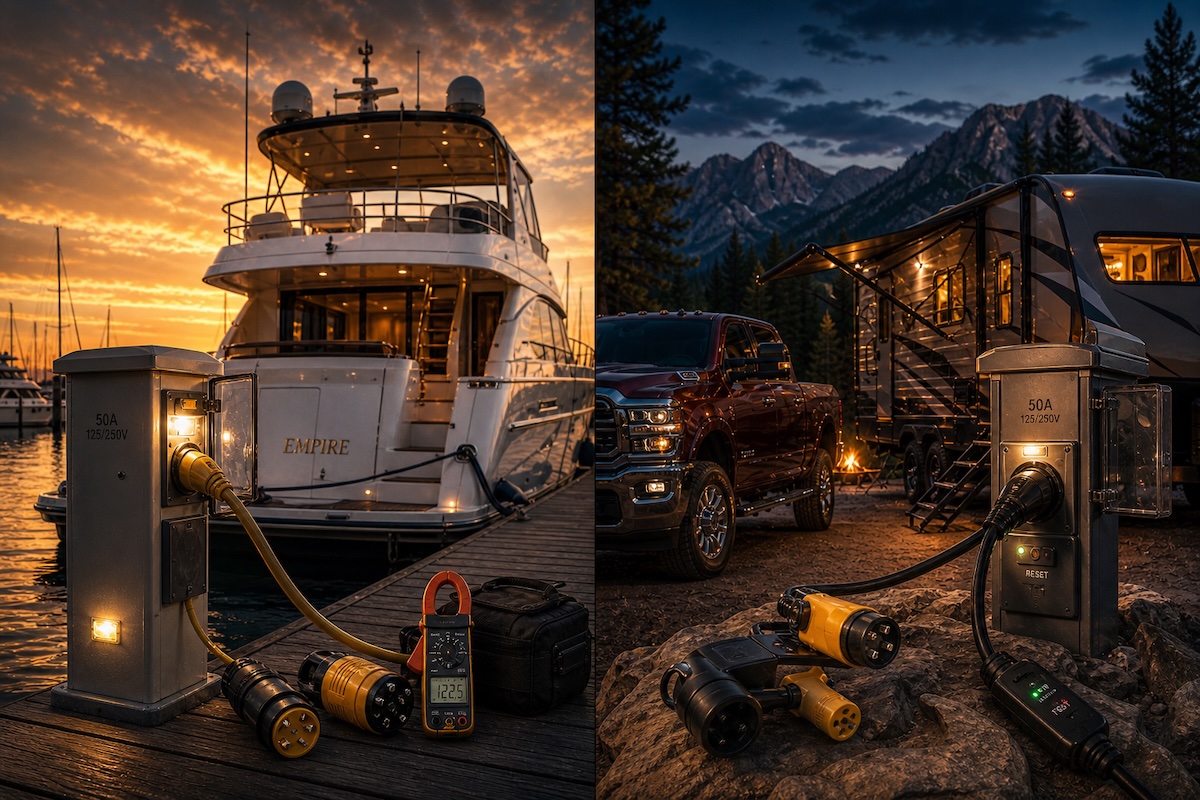
Shore Power vs. Campground Hookups Decoded: Safe Amperage, Adapters, and Ground Fault Gotchas
If you spend your life swapping docks for trailheads like we do, power pedestals become part of the adventure. One day you’re connecting shore power beside Empire, our 74-foot Hatteras motor yacht. The next, you’re plugging into a campground post.
Same idea, different rules.
Here’s the no-fluff guide to shore power vs. campground hookups: how to choose the right amperage, which adapters deserve respect, and why ground fault protection can trip at the worst possible time.
What You’re Actually Plugging Into
Marine shore power and RV campground hookups both deliver electricity through pedestal connections, but the connectors, safety rules, and environments are different.
Common marine shore power connections include:
- L5-30: 30A, 125V
- SS1-50: 50A, 125V
- SS2-50: 50A, 125/250V
Common RV campground connections include:
- TT-30: 30A, 120V
- 14-50: 50A, 120/240V split-phase
The big thing to remember: an RV TT-30 is 120V, not 240V. A marine 30A L5-30 and an RV 30A TT-30 are both 120V, but they are not the same connector and should not be treated as interchangeable.
A marine 50A SS2-50 and an RV 50A 14-50 can both provide two 120V legs, but they use different connector styles and live in very different environments. Use the correct adapter, confirm the service, and never assume a pedestal is wired correctly.
Amperage Basics
A 30A 120V connection provides about 3,600 watts of usable capacity.
That might handle:
- One air conditioner
- Battery charging
- A few outlets
- Small appliances used carefully
But microwave plus water heater plus air conditioning? That can pop a breaker quickly.
A 50A 120/240V split-phase service provides two 120V legs at up to 50A each, or roughly 12,000 watts combined. That gives you much more room for air conditioners, chargers, water heaters, and galley appliances, but the loads still need to be balanced across both legs.
The simple formula is:
Amps = Watts ÷ Volts
A 1,500-watt water heater on 120V pulls about 12.5 amps. Add a 1,200-watt microwave and a running air conditioner, and your 30A service is already out of headroom.
Voltage Matters
Low voltage is one of the quiet killers of onboard and RV electrical systems. Busy marinas and packed campgrounds can sag under heavy demand, especially when everyone is running air conditioning.
Low voltage can mean:
- Hot cords
- Angry compressors
- Dimming lights
- Tripped breakers
- Damaged appliances
A good EMS or marine-rated surge protection device can disconnect power when voltage, polarity, grounding, or surge conditions become unsafe.
Adapters: Useful, But Not Magic
Adapters can be helpful when the service is compatible. Dogbone adapters and manufacturer-approved marine or RV adapters have their place.
But some adapters are dangerous.
Avoid:
- Cheater Y-cables that combine two random 30A circuits into one 50A inlet
- Adapters that defeat ground fault protection
- Any adapter that bonds neutral to ground to stop nuisance trips
- Mismatched 30A adapters that treat TT-30 and L5-30 as interchangeable
- Damaged, overheated, corroded, or mystery adapters
Neutral and ground should not be bonded on the boat or RV while connected to shore power. The neutral-ground bond belongs at the source. Defeating that rule can create shock hazards and trip ground fault protection for very good reasons.
Ground Fault Gotchas
Ground fault protection exists because electricity escaping the intended path can hurt people, damage equipment, and create dangerous conditions around water.
Common terms:
- GFCI: common on household-style 15A and 20A outlets; designed to protect people from shock.
- GFPE: ground-fault protection of equipment; often used in marina shore power applications to detect leakage.
- ELCI: equipment leakage circuit interrupter; commonly used on boats to detect leakage from the onboard AC system.
A boat or RV that seems fine on one pedestal may trip another because the second pedestal has more sensitive protection or detects leakage the first one ignored.
That does not always mean the pedestal is bad. It may mean the pedestal is doing exactly what it was designed to do.
Common Leakage Culprits
Ground fault trips are not random. They are clues.
Common culprits include:
- Failing water heater elements
- Inverter/chargers with neutral switching issues
- Wet or damaged shore cords
- Burned or pitted plug blades
- Refrigerators
- Air conditioners
- Dehumidifiers
- Incorrect neutral-ground bonds
- Moisture in outlets, junction boxes, or cord ends
Modern marinas may trip faster than campgrounds because leakage around docks and swimmers is a serious safety concern.
Quick Pre-Plug Checklist
Before connecting at a dock or campground:
- Turn the pedestal breaker off.
- Turn the onboard main breaker off.
- Inspect the cord for burn marks, corrosion, cracked jackets, or wet ends.
- Confirm voltage, polarity, ground, receptacle type, and breaker condition.
- Connect and lock the cord.
- Turn the pedestal breaker on.
- Turn the onboard main breaker on.
- Add branch circuits one at a time.
Use equipment rated for the environment. Marine equipment should be marine-rated. RV gear should be rated for RV use.
On 30A service, stagger heavy loads. Avoid running air conditioning, water heater, microwave, space heater, and high-output battery charging all at once.
And uncoil cords fully. Heat builds when cords are coiled, undersized, damaged, or overloaded.
Field Notes from the Dock and the Road
Power problems are not just technical annoyances. They are your systems asking for protection.
A dockside ground fault trip may point to a leaking water heater element, a wet cord end, a neutral-ground issue, or an appliance bleeding current where it should not.
A campground brownout may be every rig in the park running air conditioning during a high-demand evening. If your EMS cuts power at low voltage, it may be saving your compressor, not ruining your night.
The lesson is the same whether you are aboard Empire or parked at a trailhead:
Listen to the system. Protect the equipment. Do not force power through a problem you have not identified.
The Bottom Line
- Match the connector to the service.
- TT-30 and L5-30 are not interchangeable.
- SS2-50 and 14-50 can both provide split-phase power, but only with the right cord, adapter, and wiring.
- Know your amperage and budget your loads.
- Treat ground fault trips as clues, not obstacles.
- Never bypass ground fault protection.
- Use an EMS or surge protector.
- Replace damaged cords and adapters before they become expensive problems.
Good power habits are not glamorous, but they protect the trip. They keep the air conditioning alive, the chargers happy, the dockmaster calm, and the campsite comfortable.
Want more real-world power tips from the dock, the engine room, and the campsite? Follow Anchors to Axles as we keep learning, testing, fixing, and moving between life on the water and life on the road.