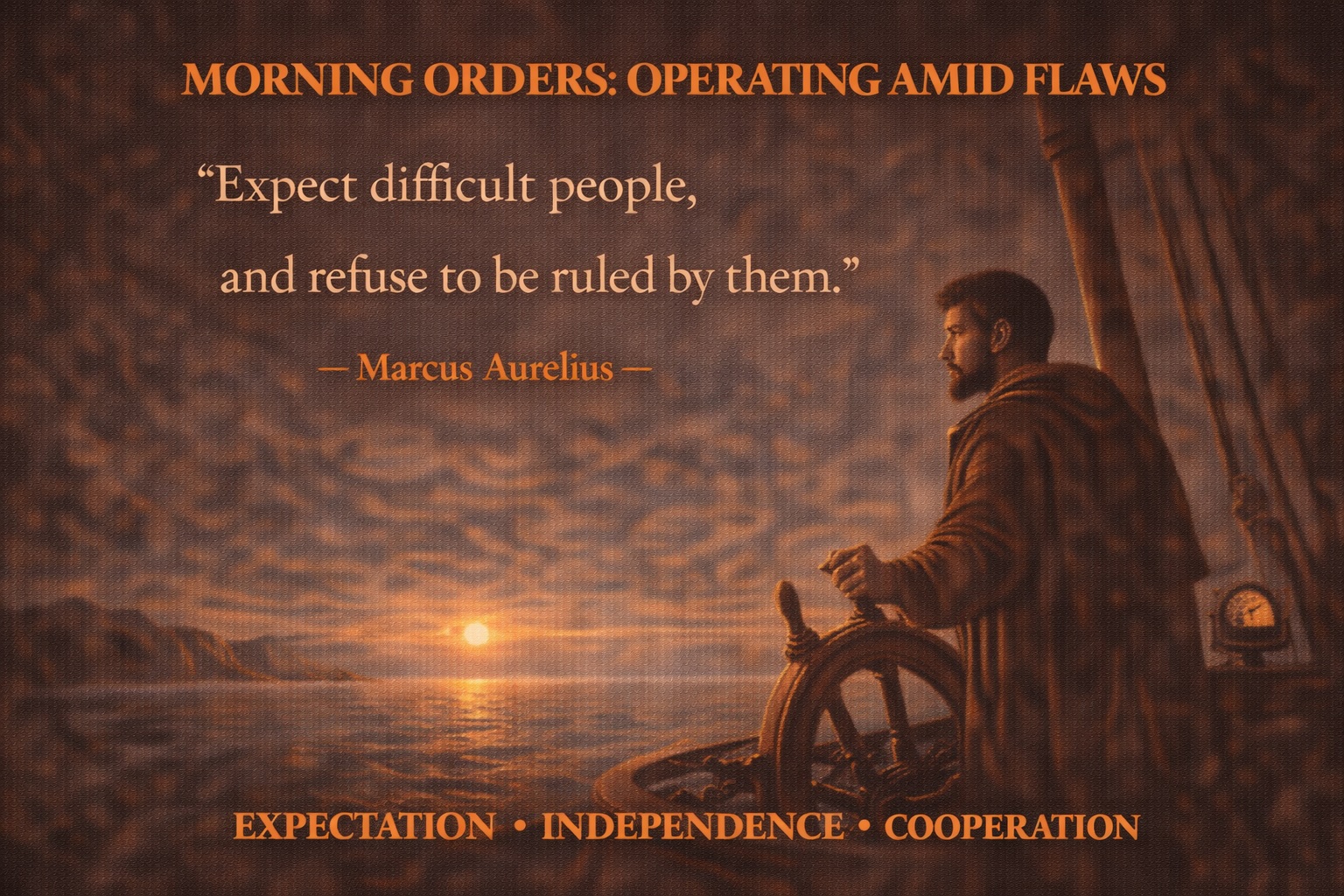
Morning Orders: Operating Amid Flaws
Marcus Aurelius begins Book II with a quiet, practical order to himself: expect difficult people, and refuse to be ruled by them. It is not a posture of superiority; it is the operating discipline of someone responsible for outcomes. Treat human friction as a normal condition. Protect your judgment. Stay fit for cooperation.
The passage is more than a moral sentiment. It is a daily procedure for leaders working in environments where decisions have consequences. It offers three integrated commitments: set expectations early, guard moral independence, and preserve the system’s capacity to work together.
Expectation as a System Setting
In engineering, the quality of a system depends on how you design for failure modes. In seamanship, a safe watch begins with a clear picture of likely risks—shoaling waters, shifting weather, tired crew. Marcus is doing the same for human behavior.
-
“Busybody, ungrateful, arrogant, deceitful, envious, unsocial” are not surprises; they are common failure modes of human systems.
-
Pre-acknowledging them reduces reactivity. What is expected is less likely to hijack your judgment.
-
Expectation does not equal acceptance. It is situational awareness that enables choice.
Leaders can adopt a morning brief: Given the pressures and incentives in play, what behaviors are likely today? Where might the system bend? What will I refuse to trade—clarity, fairness, truth—when it does?
Moral Independence, Not Indifference
“I can neither be harmed by any of them” is not bravado. It is a distinction between external behavior and internal standards. Someone can insult you. They cannot assign your character. This independence matters because anger is expensive. It shifts attention from the work to the wound.
Moral independence does not absolve others of accountability. It keeps your response clean:
-
Separate insult from impact. If harm is real (safety, fraud, abuse), act decisively.
-
If harm is performative (ego, status, slight), do not mortgage attention.
-
Hold standards without contempt. Blame rarely fixes systems; clear consequences sometimes do.
In military terms, this is rules of engagement for your character: when to ignore, when to warn, when to act—without becoming what you oppose.
Cooperation as a Design Principle
“For we are made for co-operation” is not a warm thought. It is a constraint. Nothing important gets built or maintained alone. On a vessel, cooperation is enforced by reality: no one person can navigate, trim, repair, and keep watch indefinitely. In software, reliability emerges from interface contracts and disciplined handoffs.
Cooperation improves when you make it cheap to do the right thing:
-
Share intent, not just tasks. People align faster when they know the why.
-
Write for the next person. Logs, comments, and checklists are acts of respect.
-
Normalize handoffs. Clear owners, time boxes, and after-action notes reduce drift.
-
Protect psychological oxygen. Calm voices, measured words, and punctual feedback keep the system breathable.
The opposite is also true: contempt, ambiguity, and performative urgency degrade throughput. Systems rot where respect is rationed.
Handling Failure Modes in Real Time
When you meet the “unsocial” in a meeting or the “deceitful” in a status report, default to process, not theater.
-
Name the behavior privately, not the person publicly. Precision removes heat.
-
Check your own signal. Fatigue, threat, and speed distort judgment.
-
Reduce temperature. Short sentences. Facts first. Questions before claims.
-
Choose one action: clarify, redirect, set a boundary, or escalate. Do not mix.
-
Document the lesson. Update the checklist, contract, or communication norm that would have prevented it.
This is not passivity. It is economy under pressure. The goal is preserved function, then improvement.
Using AI Without Surrendering Judgment
AI can help you prepare: simulate stakeholder reactions, draft runbooks, summarize long threads, highlight sentiment drift. It can reduce noise and surface pattern. It cannot decide what is good. “Ignorance of good and evil” is a moral category, not a classification problem.
Use AI as amplifier, not judge:
-
Pre-mortem with a model: “Where will cooperation fail today?”
-
Generate options, not orders. You choose.
-
Keep boundaries clear: decisions that affect people’s dignity, safety, or trust stay human.
Automation without understanding is brittle. Tools should sharpen attention, not replace it.
A Five-Minute Morning Drill
Aurelius’s sentence can be turned into a short operational brief. No speeches. Just settings.
-
Forecast: Today I will meet friction—busywork, ego, impatience, fear. None of it is a surprise.
-
Standard: These do not define me. I will measure myself by honesty, restraint, fairness, and usefulness.
-
Focus: What matters today? Name the two outcomes worth trade-offs.
-
Boundaries: What I will not trade—truth in reporting, safety, respect in voice.
-
Protocol: When provoked—pause, breathe, ask one question, restate the objective, choose a simple next step.
-
Cooperation: Who needs clarity from me? What handoff will I make cleaner than I found it?
Write it. Say it once. Then begin.
The Quiet Discipline
Clarity is not loud. It is the accumulation of small, durable choices made under pressure. Meditations II.1 is not about tolerating bad behavior; it is about refusing to let it draft your character or derail the mission. Expect friction. Guard your standards. Design for cooperation. Do the work.
If this perspective aligns with how you operate, subscribe to The Rissler Perspective for future essays on leadership, systems, and judgment.