
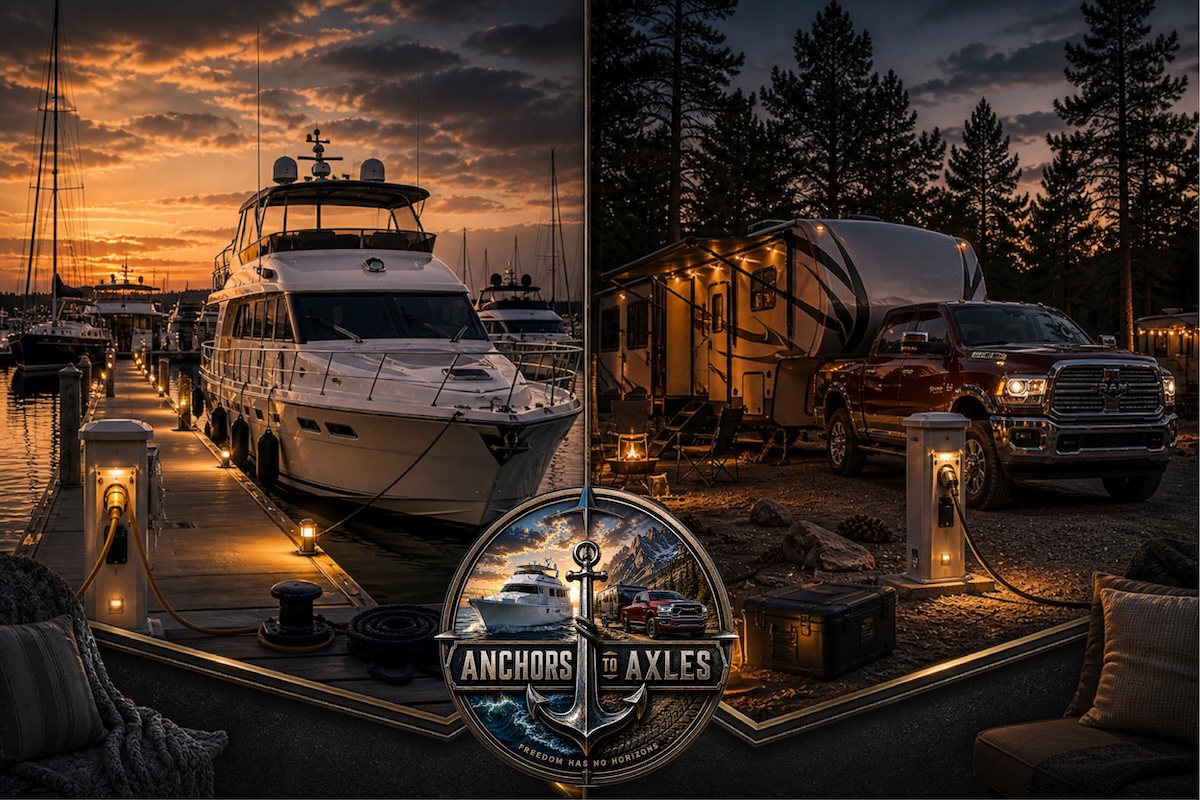
Campground vs. Marina Reality Check: What Slips Taught Us About Sites, Shore Power, Neighbors, and Sleep
If you bounce between a 74’ Hatteras and a truck and trailer, you learn something fast: a “site” isn’t just a place to park. It’s a system. Whether it’s a marina slip or an RV pad, the details of where you tie up or back in determine how your night goes.
Here’s what life on both sides – anchors and axles – has taught us about choosing the right spot, surviving sketchy shore power, dealing with neighbors, and actually sleeping when the wind or the highway decides it’s party time.
1. Site vs. Slip: How the Shape of Your Spot Changes Everything
On paper, a slip and a campsite are the same thing: a rented rectangle with utilities. In reality, the details matter a lot more than the brochure.
What we look for in a marina slip
After enough nights listening to fenders scream against pilings, this is our mental checklist:
-
Exposure to wind and fetch
A “protected” marina can still be a noisy if it’s open to a long stretch of water. If the slip faces an open bay, you’ll feel every passing wake and overnight wind shift. -
Distance from the fuel dock and charter fleet
Fuel docks mean early-morning engine starts and late arrivals. Charter boats bring rolling coolers and bachelor parties. Great for people-watching, terrible for quiet. -
Current and docking angle
Strong cross-current plus tight fairways equals drama. We’ve had “simple” dockings turn into slow-motion wrestling matches because the slip looked fine on a map but was a nightmare in real life. -
Finger pier length and piling layout
Short finger piers and wide slips are common with bigger boats. That means creative line setups and weird boarding angles. Doable, but it changes how securely you can tie up and how much you’ll move at night.
What we look for in an RV campsite
On land, the variables are different but just as critical:
-
Proximity to roads and amenities
That pull-through spot near the bathhouse and playground? Convenient by day, chaos by night and sunrise. We’ve traded those for back-in sites further out and slept way better. -
Slope and leveling
Photos don’t show grade. Being six inches out of level means your fridge isn’t happy and you’re rolling into one side of the bed. We now assume we’ll need blocks unless clearly stated “perfectly level” – and even then, we’re suspicious. -
Surface material
Gravel drains and stabilizes. Grass gets muddy and attracts bugs. Broken concrete chews up stabilizer pads. The ground matters way more after the first rainstorm.
Lesson: Don’t just ask, “Is there a spot?” Ask how it’s oriented to wind, water, roads, and traffic – and what the actual access and surface look like. The rectangle is never just a rectangle.
2. Shore Power Quirks: Pedestals, Panels, and “Why Is That Smoking?”
Both lifestyles depend on plugging into someone else’s electrical system. Both can bite you if you trust blindly.
Marina shore power reality
We love marinas, but we don’t trust their electrician by default.
Common slip surprises:
-
Low voltage on hot days
When everyone’s running air conditioning, voltage can sag. On Empire, we’ve seen 208V or less on a “240V” feed. That’s a great way to shorten the life of compressors and electronics. -
Worn or corroded pedestals
Loose connections get hot. We’ve unplugged from pedestals that were warm to the touch and seen discoloration around outlets. That’s a warning sign, not a cosmetic issue. -
Miswired or mislabeled connections
30A labeled as 50A, reversed polarity, or shared circuits you don’t know about. A twist-lock plug that “almost” fits is not your friend.
Our non-negotiables now:
- Use a voltage/amp meter to check the pedestal before committing.
- Inspect the plug and receptacle for heat or discoloration.
- Run surge protection and monitoring, not just blind faith in the breaker.
RV shore power reality
RV parks feel familiar if you’re used to marinas: weather-beaten pedestals, improvised “fixes,” and neighbors that run everything off one aged outlet.
What we’ve learned:
-
Always test before you trust
A basic plug-in tester plus an EMS (Electrical Management System) has saved us from low voltage, open grounds, and reversed polarity more than once. -
Know your rig’s actual draw
A 30A pedestal isn’t a suggestion. Running two AC units, the microwave, and water heater on electric will find the weak link in the system – and sometimes, that’s inside your own breaker panel. -
Don’t be the problem neighbor
If your setup trips the pedestal breaker every hour, you’re not just annoyed; you’re also cooking connections and annoying everyone on that loop.
Lesson: Boat or RV, shore power is not “set and forget.” Meter it, protect it, monitor it. Replace “it should be fine” with “I verified it.”
3. Neighbor Etiquette: Docks vs. Campground Culture
The water crowd and the RV crowd have different rhythms, but the same basic rules keep things sane.
Marina neighbor dynamics
Marinas can be:
- Floating neighborhoods with dock parties, sunset drinks, and the occasional 2 a.m. karaoke.
- Working docks where liveaboards are up early, move equipment, or wrench on engines at odd hours.
What’s shifted our experience:
-
Simple introductions
Walking over, introducing ourselves, and asking, “Hey, what’s the noise like here at night?” has given us more honest intel than any dockmaster. -
Being visible and respectful with projects
Grinding rust at sunrise or running the generator dockside for hours makes enemies fast. We try to batch loud work, warn the neighbors, and keep tools and parts from spilling into shared space. -
Lines and fenders as etiquette
A well-fendered boat and clean line setups aren’t just seamanship – they’re neighborly. Your motion and wake transfer to their sleep.
Campground neighbor dynamics
The RV side has its own style:
-
Generators and quiet hours
The fastest way to become “that rig”? Ignore quiet hours with a screaming open-frame generator. We size our battery/solar setup so we’re not forced into bad etiquette. -
Lights and fires
Floodlights and LED light bars might be great for Instagram; they’re brutal for someone trying to stargaze or sleep. Same with smoky fires right under someone’s bedroom window. -
Audio discipline
Your outdoor speakers face someone’s campsite. Keeping the volume modest is the difference between “cool neighbors” and “we’re leaving a day early.”
Lesson: In both worlds, the bar is low. Communicate, keep your chaos mostly contained, and respect quiet hours. You’ll get it back when you need it.
4. Getting Real Sleep: Wind, Wakes, and Highway Noise
The biggest surprise for many boaters and RVers isn’t the maintenance; it’s how hard it can be to sleep well in a moving (or vibrating) box.
Sleeping aboard in a slip
Things that have stolen our sleep on the yacht:
-
Wind shifts that change every sound
A gentle breeze can turn into lines groaning, fenders squeaking, and mast hardware clanking. Nothing “broke,” but your brain doesn’t know that at 2 a.m. -
Ferry and fishing boat schedules
If there’s a commercial route nearby, expect pre-dawn wake trains. We now ask specifically about traffic: “Any ferries, tugs, or early charter departures?” -
Poorly tuned lines
We’ve had nights ruined by our own laziness. Once we learned to spring the boat fore and aft, add chafe gear, and preload lines for changing tides, the noise and motion dropped dramatically.
Our go-to fixes:
- Extra fenders and chafe protection
- Adjusting lines for forecast wind direction, not just current conditions
Sleeping in campgrounds
Land doesn’t roll, but it has its own tricks:
-
Highway and truck noise
“Convenient access to the interstate” means you’ll hear every Jake brake and late-night semi. Distance and trees matter more than the brochure language. -
Campground culture cycles
Weekend warriors run late. Long-term residents are up early. Pick your neighbors accordingly when you can. -
Temperature swings
On the boat, water temp moderates nights. In an RV, you can cook at sunset and freeze by 3 a.m. Good insulation, fans, and ventilation make the difference between “cozy” and “can’t sleep.”
Our rhythm now:
- Choose back-row or perimeter sites over “convenience” when possible.
- Use vent fans and airflow to reduce AC cycling noise.
Lesson: Great sleep doesn’t just happen. It’s a system: where you park, how you tie or level, and how you manage noise, motion, and temperature.
Final Thought: The Adventure Lives in the Details
Campgrounds and marinas sell the same dream: sunsets, freedom, and a life unhooked from the usual routine. The reality is more nuanced, and that’s where the good stories come from.
Choosing the right slip or site, taming sketchy shore power, handling neighbor dynamics, and engineering your own good night’s sleep – that’s the unglamorous side that makes the glamorous side possible.
At Anchors to Axles, we’re here for that full picture: the wins, the fails, the windy nights, and the highway hum.
Want more real-world lessons from the dock, the engine room, the campsite, and the road? Follow along with Anchors to Axles and turn your own next slip or campsite into a smarter, smoother adventure.