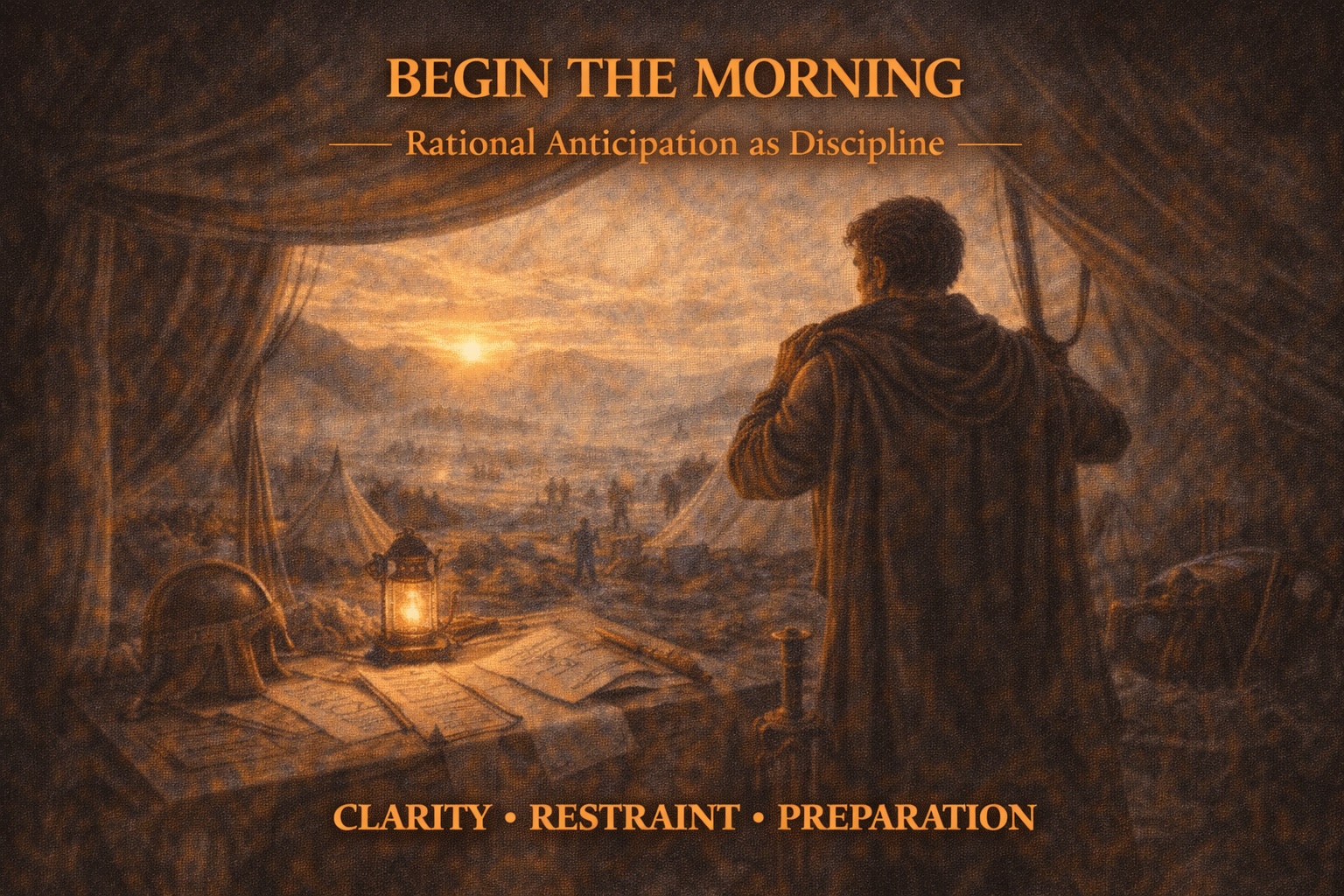
Begin the Morning: Rational Anticipation as Discipline
Marcus Aurelius opens Book II with a simple instruction: begin the morning by reminding yourself you will meet difficult people. In some editions, the meditation continues as a distinct section: expect interference, ego, misalignment—and remember why you won’t be harmed by it. Stoicism treats this forethought not as pessimism, but as clarity. You inoculate judgment by removing surprise. Resentment finds less oxygen when the day unfolds roughly as planned.
This is not a pep talk. It’s a posture. In real systems—ships, teams, software, markets—friction is not an exception. It is the default state. A leader who treats friction as a moral insult burns time and trust. A leader who anticipates it preserves both.
Forethought is a Control Surface
Rational anticipation is a control surface for the day. You cannot control outcomes; you can control your stance toward predictable human behavior:
-
People will protect status, sometimes at the cost of truth.
-
Communication will drift. Assumptions will calcify.
-
Tools will misbehave. Models will hallucinate. Weather will change.
-
You will be tempted to move faster than understanding.
None of this is new. What matters is whether you are surprised by it. Surprise is expensive. It shifts you into resentment, then into reaction. Forethought converts the same stimulus into a known variable. You still enforce standards, but without the corrosive story that you’ve been personally wronged.
A Systems View: Schedule Reality into the Plan
On a boat, you plan the passage you want and the backup routes you may need. In engineering, threat models and error budgets assume components will fail. In command, standing orders exist because fatigue and stress will degrade judgment. These are all versions of the same move: schedule reality into the plan.
When the morning meditation says “expect the busybody,” it is a human factors checklist. It resets your model of the environment and your own tendencies under load. You are less likely to escalate, overfit, or drift.
A Morning Protocol for Leaders and Builders
Seven minutes. No ceremony. Just calibration.
-
Name the frictions you will likely meet today
-
A defensive stakeholder. A terse code review. A contractor who slips schedule. A model output that looks confident and is wrong.
-
Choose your posture in advance
-
Curious, firm, restrained. You don’t need to match tone. You need to maintain standards and conserve energy.
-
Set your rules of engagement
-
What you will not do: argue by email, commit unreviewed code, sail on a forecast you wouldn’t accept at night.
-
What you will do: ask for primary data, write decisions down, pause when you feel heat.
-
Pre-commit a response to the predictable failure
-
“If X misses again, we move to plan B without commentary.”
-
“If the model contradicts the logbook, the logbook wins until reconciled.”
-
Clarify the point of the day
-
One non-negotiable outcome. The rest is maneuver.
This isn’t “think positive.” It’s pre-briefing your mind the way you’d pre-brief a crew: here’s the water, here’s the weather, here’s how we’ll handle contingencies.
Examples Across Domains
-
Engineering
The incident review is today. You expect defensiveness. You open by separating blame from learning, insist on timelines and data, and hold the line on root cause without theatrics. Because you expected the heat, you don’t add yours to it.
-
Maritime
The weather window is marginal. You’ve already decided on the no-go criteria. When enthusiasm pushes to depart, you point to the criteria and stand down. The “no” isn’t personal. It’s procedural.
-
Entrepreneurship
An investor will probe vanity metrics. You resist the urge to posture. You show unit economics and cash runway, and you leave the room liking yourself.
-
Working with AI
You expect fluent nonsense. You bound the problem, constrain the model, and verify outputs against a simple ledger. Automation serves judgment, not the reverse.
Anticipation Without Cynicism
Stoic forethought can drift into fatalism if you strip it of its finishing steps. Avoid that slide.
-
Remember shared purpose
“We are made for cooperation,” Marcus writes. The person opposing you may be protecting something real. Look for the useful signal inside the noise.
-
Make room for surprise in the other direction
Anticipate failure; remain open to excellence. When someone exceeds the model, update it.
-
Keep standards intact
Forethought softens resentment, not accountability. Clarity is not indulgence. It is the precondition for fair enforcement.
-
Inspect your own contribution
If you meet the same friction daily, part of the system is you. Change a process, a cadence, or a boundary.
Close the Loop: An Evening Debrief
Morning intent only matters if it survives contact. Ten minutes to end the day:
-
What frictions occurred? Which did I predict?
-
Where did resentment try to recruit me? What defended me?
-
What will I change in tomorrow’s pre-brief?
-
What decision deserves a written note for future me?
This preserves experience as compound interest. The journal becomes a logbook, not a diary—useful later when memory tries to revise history.
The Quiet Output: Freedom from Resentment
Resentment is a tax on attention. Leaders operating under uncertainty can’t afford it. Marcus’s morning exercise is an ancient way to lower that tax: see the day as it is likely to be, choose your posture, and keep your responsibilities clean. The work doesn’t get easier. Your relationship to it gets steadier.
If this lens is useful, subscribe to The Rissler Perspective to follow future essays on leadership, systems, and judgment under pressure.