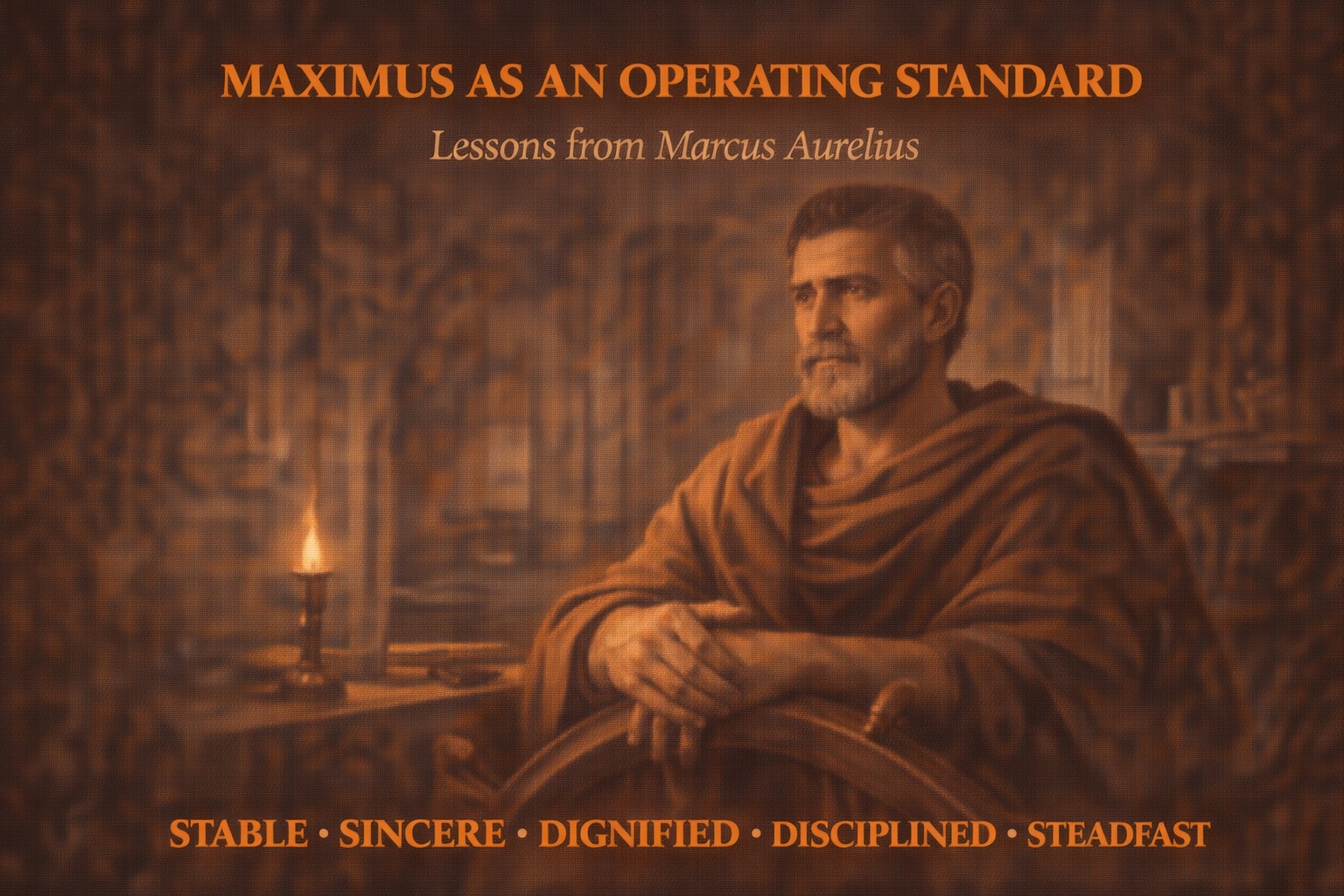
Maximus as an Operating Standard
Marcus Aurelius’ portrait of Maximus in Meditations I.15 is not motivational ornament. It’s an operational spec for a human being: self-governed, steady, sincere, and quietly unshakable. The Stoic ideal here isn’t superhuman control. It’s constancy built from reasoned habits that hold under pressure.
I read it as guidance for leading systems—ships, teams, companies, codebases—where stakes are real and attention is finite. The traits Marcus names are not virtues to admire at distance; they are behaviors that scale. They reduce noise, conserve energy, and make good outcomes repeatable.
Self-Government as an Internal Control System
“Self-government” is the core. In practice it looks like an internal control loop: sense, decide, act, review. It resists external turbulence by clarifying inputs and constraining outputs.
-
Inputs: facts, not rumors; ground truth, not mood.
-
Decision rules: pre-committed principles, not ad hoc exceptions.
-
Actions: proportionate, timely, reversible when possible.
-
Review: after-action, not after-justification.
On watch at sea, self-government is literal: you don’t outsource judgment to the weather or the radio. In an engineering org, it’s refusing to let metrics or investor mood become your conscience. Tools can inform; they don’t absolve.
Calm in All Weather
Maximus “was never in a hurry, and never put off doing a thing.” That’s controlled tempo. The work gets done now, without panic.
In practice:
-
Separate urgency from haste. High tempo without sloppiness.
-
Keep a latency budget for decisions. Short for reversible calls; longer for one-way doors.
-
Build slack deliberately. Margins are not waste; they’re insurance.
-
Standardize the ordinary so you have bandwidth for the exceptional.
Panic is a contagion in crisis. Calm is, too. The leader sets the organization’s nervous system. When you don’t spike, the system learns not to.
Sincerity Without Performance
Marcus notes that everyone believed Maximus “thought as he spoke,” and he “never showed amazement,” never disguised vexation with laughter. That’s a clean signaling channel—no theatrics, no sarcasm as cover.
Practical moves:
-
State intent up front. “Here’s what I’m trying to achieve and why.”
-
Use plain language. Precision beats vocabulary.
-
Name your constraints and your uncertainty. People can adapt to truth; they can’t adapt to fog.
-
Don’t perform positivity to manage optics. Credibility outlasts a grin.
In complex systems, alignment depends on the fidelity of your signals. Sincerity isn’t sentiment; it’s engineering.
Sweetness and Dignity
Maximus mixed “sweetness and dignity.” Not softness and severity, but kindness with spine.
-
Dignity sets boundaries: what you won’t do, what you won’t tolerate.
-
Sweetness preserves relationship while enforcing those boundaries.
With crew, with engineers, and with clients, this combination keeps morale and standards intact. Kindness without dignity breeds drift; dignity without kindness breeds fear.
The Discipline of Execution
“He did what was set before him.” Duty is local and concrete. Great strategy is useless if the next task dies in the inbox.
-
Triage ruthlessly. Decide, delegate, or delete.
-
Close loops. Confirm completion; don’t assume it.
-
Replace “later” with a time and owner.
-
Put time on the calendar for maintenance—of code, of hulls, of relationships.
The bias to action does not mean doing more. It means moving the right items to Done.
Forgiveness, Trust, and Durable Systems
Maximus did “acts of beneficence,” was “ready to forgive,” and “free from all falsehood.” In high-reliability environments, forgiveness is not leniency—it’s system design.
-
Run blameless postmortems. Assign responsibility without humiliation.
-
Keep an error budget. Acknowledge the cost of learning and the cost of denial.
-
Tell the truth early, especially when it hurts you. Truth is a compounding asset.
Teams that expect fairness take more responsible risks. Teams that fear punishment hide information until it’s too late.
Not Diverted From Right
He appeared “a man who could not be diverted from right.” That’s different from someone who “has been improved.” The point isn’t to display growth. It’s to be governed by invariants that hold across context.
Define your invariants:
-
We don’t lie.
-
We don’t trade safety for speed.
-
We don’t ignore unowned risk.
-
We don’t allow tools to make moral choices for us.
Write them down. Rehearse them. Let people test them. Make them expensive to violate.
Working With AI Without Surrendering Judgment
Tools amplify tendencies. If you are hurried, AI makes you faster at being hurried. If you are clear, AI helps you be clearer.
Use intelligent systems to:
-
Generate options, not decisions.
-
Challenge assumptions with adversarial tests.
-
Surface edge cases and failure modes.
-
Reduce clerical load so you can think.
Never let automation float free of intent or accountability. If you can’t explain a tool’s output in your own words, you don’t own the decision.
Practices That Build Constancy
Constancy is trained. Habits beat heroics.
-
Morning intent statement: three commitments and one non-negotiable.
-
Decision journal: record context, options, chosen path, predicted outcome. Review weekly.
-
Pre-mortem before major actions: “How did this fail?” Then fix those paths in advance.
-
After-action reviews within 24 hours: facts, findings, fixes—no theater.
-
Tempo control: block uninterrupted time; protect slack; say no cleanly.
-
Maintenance cadence: technical debt, equipment checks, personal fitness, sleep.
-
Communication standard: explicit intent, constraints, and next actions in writing.
-
Boundary drills: practice saying, “I don’t know,” “Not yet,” and “No.”
I fail at some of these more often than I’d like. The point is not a streak. It’s a direction.
The Quiet Work
Marcus admired Maximus because his character was integrated, not advertised. That is the work: fewer spikes, fewer excuses, clearer intent, steadier hands. Not perfection through struggle, but constancy through habit.
When the weather is fair, you build the habits. When it turns, you discover which habits built you.
If this perspective aligns with your own practice, subscribe to The Rissler Perspective to follow future essays and field notes, or reach out to continue the conversation.