The Stoic Trilemma as an Operating Assumption
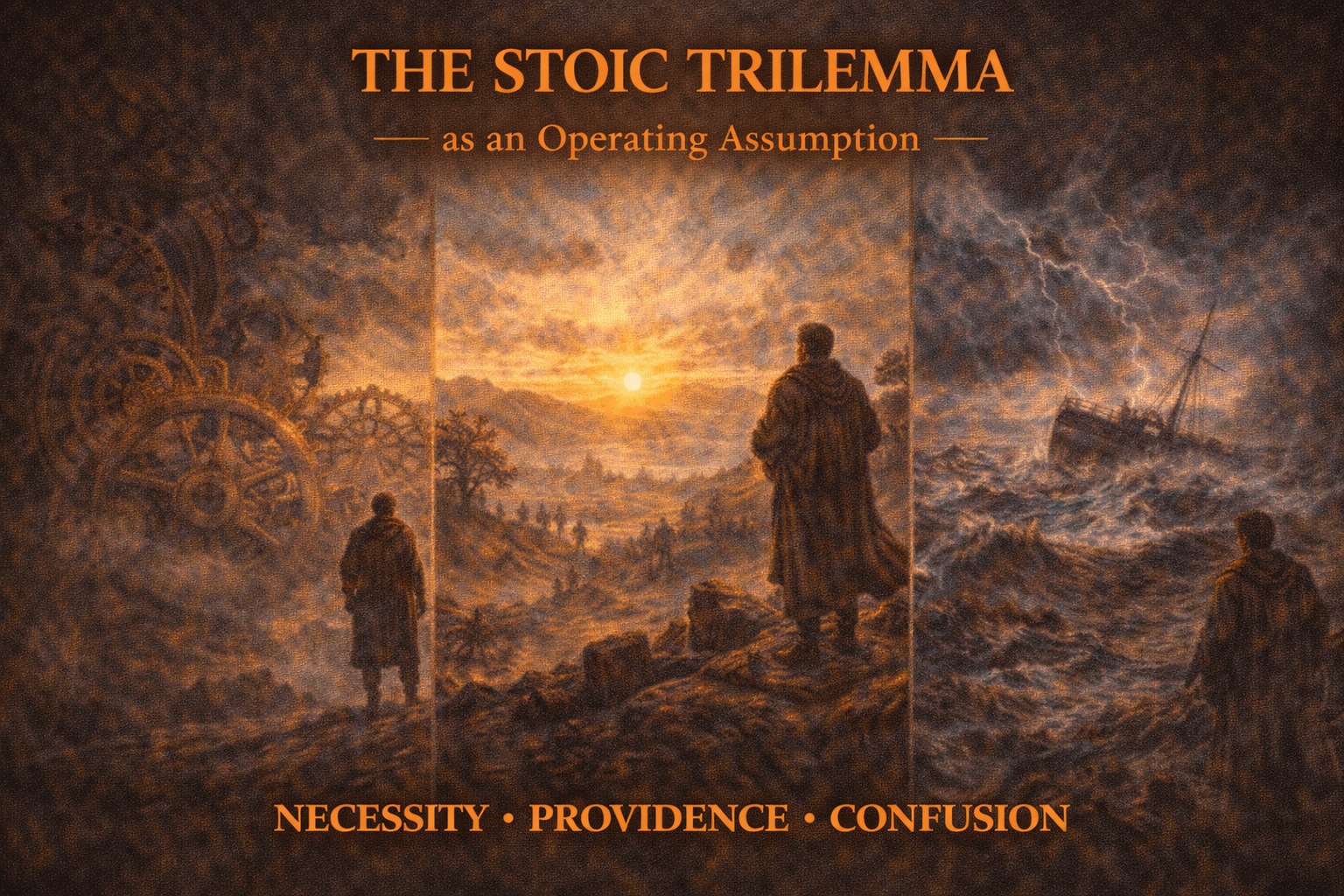
“Either there is a fatal necessity and invincible order, or a kind Providence, or a confusion without a purpose and without a director.” Marcus Aurelius’ trilemma doesn’t try to solve metaphysics. It asks a simpler, harder question: how should we act, given any of these may be true? The Stoic answer is practical — reasoned conduct is the constant duty, regardless of whether the universe is deterministic, benevolent, or indifferent.
For leaders, builders, and operators, this principle reads like a field manual. High-stakes decisions rarely arrive with metaphysical clarity. They arrive with deadlines, incomplete information, and consequences. The discipline is to structure your actions so they are coherent and responsible in all three worlds.
Three Frames, One Standard of Conduct
The trilemma can be carried as a checklist for perspective:
-
If necessity rules: Accept constraints, read the causal chain, and align action with reality’s mechanics.
-
If Providence governs: Choose the good deliberately — act with integrity and service beyond self-interest.
-
If confusion prevails: Build resilience to randomness; favor robustness over elegance.
What endures across all three is a commitment to reason, responsibility, and measured execution.
What Endures Under Any Cosmos
Whether I am at the helm in deteriorating weather or shepherding a brittle production system during an outage, the posture is the same:
-
Clarity of role and objective: Define the purpose of the next action.
-
Attention to the near horizon: Prioritize what matters in the next minute, hour, and day.
-
Discipline over impulse: Procedures exist to carry you through stress.
-
Accountability: Own the decision and its consequences; invite critique after the fact.
-
Feedback loops: Observe, adjust, and document so the system learns.
These are not abstractions. They emerge from pressure where theory breaks, and judgment must carry the load.
A Sea Trial, a Postmortem, the Same Lesson
At sea, autopilot failures don’t announce themselves. The helm goes stiff; the wind shifts thirty degrees; the crew is green. You reef, hand-steer, call out bearings, and reassign roles. Nobody debates whether fate, Providence, or chaos is in charge. You work the problem, follow checklists you’ve rehearsed, and keep the boat and people safe.
In software, a production incident feels similar. Latency spikes, dashboards disagree, customers are affected. You triage, execute a rollback, isolate the fault, and communicate. You don’t outsource judgment to hope or panic. You lean on runbooks, minimum viable fixes, and clear chains of command.
Different domains. Same conduct. The trilemma is a reminder that our duty doesn’t depend on the universe being tidy.
Designing Systems for All Three Worlds
Build systems — technical and organizational — that remain responsible under determinism, Providence, and chaos.
-
Design for necessity: Respect constraints. Model dependencies. Use type systems, interface contracts, and mechanical sympathy. In ships and software, physics and throughput win arguments.
-
Honor Providence: Embed ethics in design. Set guardrails that protect people and data. Write SOPs that prioritize safety and dignity when timelines compress.
-
Prepare for confusion: Expect partial failures. Use redundancy, graceful degradation, and circuit breakers. Favor simple, observable architectures over fragile cleverness.
Practical mechanisms:
-
Pre-mortems and red-team reviews to pressure-test assumptions.
-
Checklists and drills to carry execution under stress.
-
Clear escalation paths and decision authority to prevent paralysis.
-
Debriefs that turn errors into institutional knowledge, not blame.
Integration over optimization is the theme. A system that only works when it’s sunny is not a system.
Leadership When Stakes Are Real
Leadership under uncertainty is not charisma; it is stewardship. It looks like:
-
Intent first, plans second: Communicate purpose and boundaries so teams can adapt without constant permission.
-
Standards that travel: When you’re not in the room, the standard should be.
-
Composure as a control surface: Your calm signals what matters and what does not.
-
Small, reversible moves: When information is thin, choose actions you can roll back. Reserve irreversible decisions for when you must, and then own them.
-
Honest clocks: When time is the constraint, say so. When risk is the constraint, say so. Naming the constraint reduces noise.
This is not romantic. It is work. And it is durable across the trilemma.
Humans and AI: Tools, Boundaries, Accountability
If the universe is necessity, AI will magnify our capacity to model and predict. If Providence, we owe our tools ethical alignment. If confusion, AI’s brittleness is a risk surface. In all cases, human judgment remains the governor.
Operating principles:
-
Treat AI as a fallible sensor, not an oracle. Require verification, especially for safety-critical or reputationally sensitive work.
-
Define boundaries of automation. What is delegated, what is assisted, and what remains inherently human?
-
Log decisions and rationale. Audit trails convert uncertainty into learnable history.
-
Design handoffs. When the model is uncertain, the human takes the conn.
Automation without understanding is fragile. Use technology to sharpen thinking, reduce noise, and support better decisions — not to abdicate responsibility.
A Compact for Daily Decisions
Before committing, I run a short mental drill:
-
What is actually mine to decide?
-
What objective am I serving, and what constraint dominates?
-
How would I act if the world were deterministic? Benevolent? Chaotic? What action survives all three?
-
Is this decision reversible? If not, what more do I need to know?
-
What standard would I be proud to defend in a debrief?
This compact does not make the world simple. It makes my conduct less fragile.
Acceptance as Discipline
The trilemma is not a riddle to solve but a posture to hold. Whether events unfold by fixed necessity, guided order, or noise, the work is the same: see clearly, decide deliberately, act with restraint, and accept responsibility. Reasoned conduct is not a guarantee of outcomes. It is a commitment to be the kind of person whose actions can be trusted when outcomes are uncertain.
If this perspective aligns with how you operate, explore the archive or subscribe to The Rissler Perspective for future reflections.