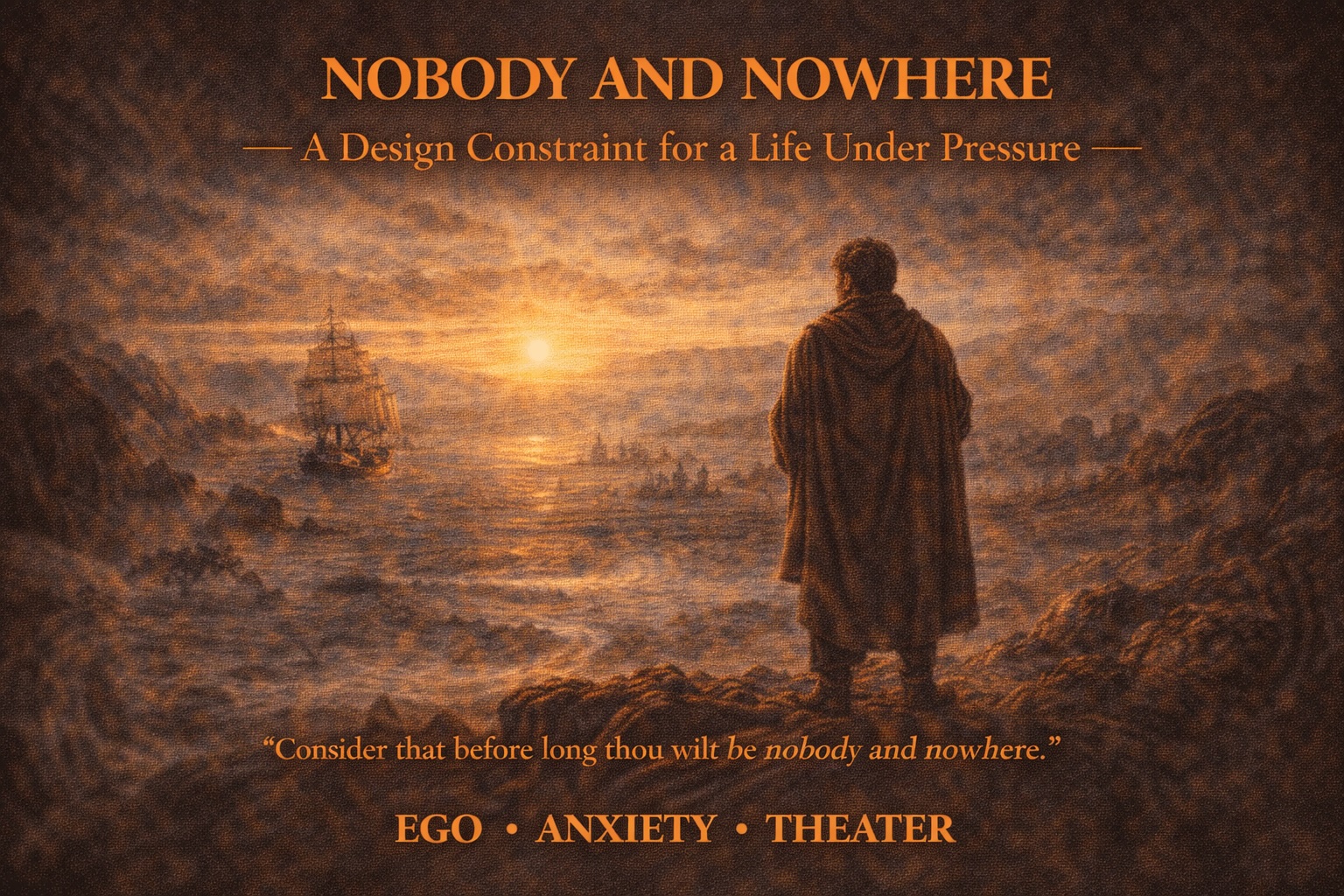
“Nobody and Nowhere”: A Design Constraint for a Life Under Pressure
“Consider that before long thou wilt be nobody and nowhere.” In Book II of Meditations, Marcus Aurelius compresses perspective. The line is not morbid; it is operational. It strips away the noise around status, fear, and performance anxiety, and leaves only duty. In complex domains—ships at sea, production systems, teams under strain—that discipline matters.
A Compressed Horizon
Leadership often gets hijacked by the near horizon: reputation, optics, the next review. Compressing perspective—remembering that vanities expire, including ours—changes how we allocate attention. The questions become simpler and harder at the same time:
-
What is mine to do right now?
-
What consequences endure beyond my sentiment?
-
What system am I shaping by this decision, not just what problem am I fixing?
Transience does not trivialize the work; it clarifies it. When you stop negotiating with your image, you can serve the task, the team, and the truth with fewer detours.
Nobody and Nowhere as a Design Constraint
Treat impermanence the way an engineer treats power budget or a captain treats draft: as a hard limit that informs design.
Leadership without the costume
On deployment, the evaluation that mattered most was not praise in the moment but whether the watch stood tighter after you left the bridge. When you accept that you’ll be “nobody and nowhere” soon, you lead for transfer, not spotlight:
-
Write decisions so the next person can reconstruct your judgment.
-
Replace personality with procedure where possible; reserve personality for judgment calls.
-
Make praise private and corrections precise; both are for the work, not your aura.
Engineering with an expiry date
In software architecture, the future is short and uneven. Assume your service, your stack, your name in the commit history—none endure. Build accordingly:
-
Include an “expiry statement” in design docs: what assumptions age out and when.
-
Favor legibility over cleverness. The next engineer will not care how inventive you felt.
-
Make rollbacks cheap. Systems that can’t be undone demand too much of human infallibility.
Seamanship and the vanishing self
Night approaches a lee shore. The question is not how competent you look threading a narrow inlet; it’s how certain you are. If the margin is thin, heave-to and wait. Nobody at the marina will applaud restraint, but the crew will have breakfast.
What the Reminder Removes
The sentence dissolves three common distortions:
-
Ego: The need to be seen as essential. Good systems reduce your centrality.
-
Anxiety: The fear of looking wrong. If you will be forgotten, you can afford to be correct.
-
Theater: Ornamented leadership that optimizes for attention rather than outcomes.
Remove these and the remaining work is mostly craft, coordination, and care.
What the Reminder Demands
Impermanence is not an excuse to disengage. It imposes responsibility:
-
Stewardship: Leave systems cleaner than you found them—docs, interfaces, habits.
-
Candor: Speak plainly about risk and trade-offs. Clarity is a form of respect.
-
Accountability: Own the choice, not the narrative around it. Debrief without hedging.
Practical Cadences to Keep Perspective
These are small, repeatable practices that turn the line from Aurelius into muscle memory.
-
Pre-mortem by time horizon: If we dissolve in 5 years, what still matters tomorrow, next quarter, next year? Design for the smallest horizon that carries real consequences.
-
Decision log with one sentence of intent: “We chose X to protect Y under constraint Z.” When the future team reads it, they inherit judgment, not just outcome.
-
Obsolescence tags: Every dashboard, document, and feature gets a review date. If nobody renews it, retire it. Dead artifacts drain attention.
-
Rollback drills: Practice unwinding changes the way you practice man-overboard. Reversibility is a virtue.
-
Sunset rituals: End initiatives on purpose. Archive, summarize lessons, state what not to repeat. Closure is a system function, not an afterthought.
-
“Next watch” mentality: Write as if your relief arrives exhausted at 0200 in weather. Can they see what you saw?
Work Under Uncertainty
Uncertainty tempts leaders to compensate with projection. The nobody/nowhere constraint suggests a different posture:
-
Separate reversible from irreversible decisions; bias speed for the former, deliberation for the latter.
-
Choose the smallest sufficient commitment. Keep options open without becoming noncommittal.
-
Measure effect, not effort. If a move doesn’t change a behavior, it’s theater.
In a startup, that might mean killing a well-loved feature that confuses users. In a unit, it might mean simplifying a plan until the newest member can brief it back. In a refactor, it might mean leaving a perfectly good optimization untouched because it increases cognitive load.
AI, Permanence, and the Illusion of Legacy
AI promises recall: logs that never fade, models trained on everything you’ve produced. It tempts us to chase a synthetic immortality of artifacts. Resist it. Tools should amplify judgment, not preserve vanity.
-
Use AI to reduce noise and surface signal—summarize debriefs, test assumptions, expose edge cases.
-
Do not outsource intent. The system should never be confused about who is accountable.
-
Assume your data will outlive you and be misinterpreted. Write for the future with restraint and context.
Automation without understanding is brittle. Clarity without context misleads. The point is not to be remembered; it’s to make better decisions now, for people who will never know your name.
The Working Test
When choices blur, apply a short test drawn from the line:
-
If I were nobody soon, what would I protect?
-
If I were nowhere soon, what could I responsibly leave behind?
-
If my name disappeared from this, would the system still work?
If the answer embarrasses your current plan, adjust.
Less Self, More Duty
“Before long thou wilt be nobody and nowhere” is not a dismissal of life; it is a release from self-importance. What remains is duty, craft, and care for systems and people. When we design for a world that forgets us, we often build the most durable things we’ll ever touch.
If this perspective is useful, follow The Rissler Perspective for future essays on leadership, systems, and judgment under real constraints.