
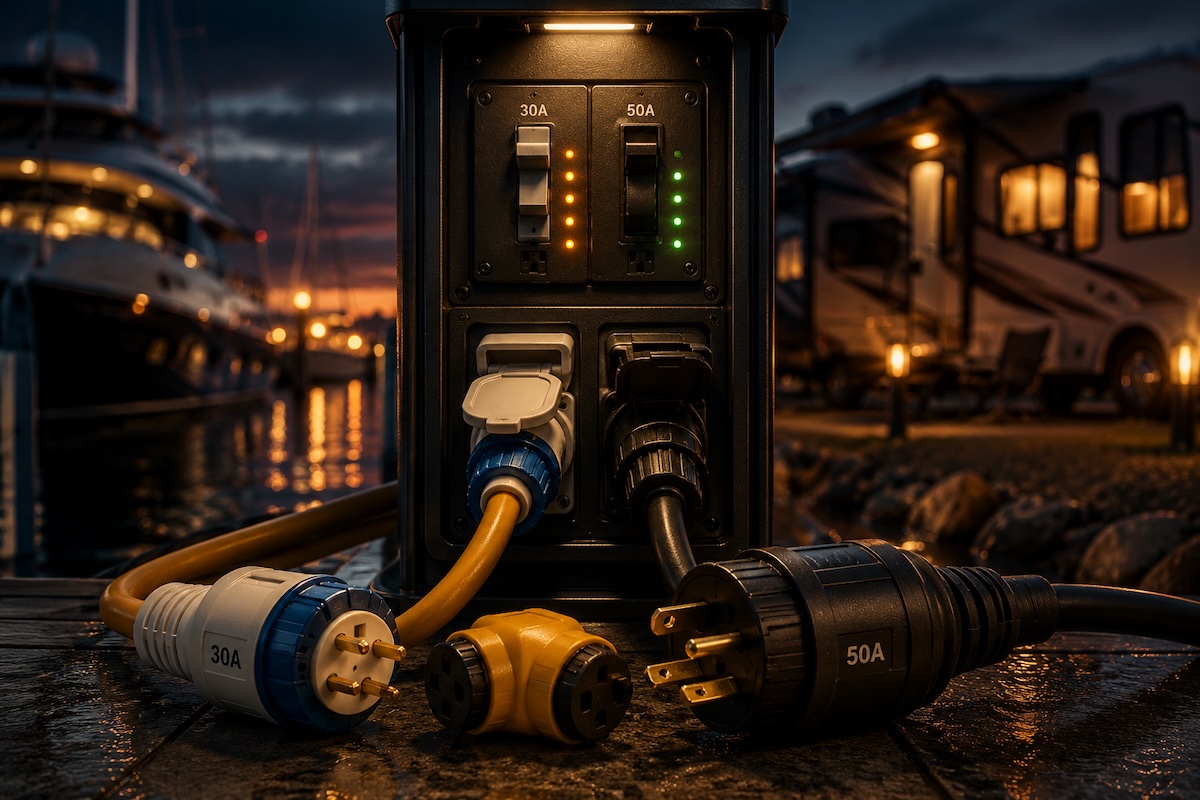
30 Amp vs 50 Amp Shore Power: What It Really Means for Boats and RVs
If you’ve ever tripped a marina pedestal or melted an RV plug at a campground (ask us how we know), you’ve felt the difference between 30 amp and 50 amp the hard way. Here’s the clear, honest guide to what 30A vs 50A shore power actually is, how the plugs differ on boats and RVs, and how to manage loads so you stop playing breaker roulette.
The quick math: amps, volts, and real capacity
- Watts = Volts × Amps. That’s the whole game.
- 30A at 120V ≈ 3,600 watts available.
-
50A service in North America is usually split-phase: two 120V “legs” that are 180° out of phase.
- Total capacity ≈ 50A × 120V × 2 = 12,000 watts (12 kW).
- Some boats also use 240V loads across the two legs (chillers, cooktops, dryers).
More watts = more things can run at once without popping breakers or starving motors during startup.
Plugs and voltages you’ll actually see
RV pedestals (North America):
- 30A RV: TT-30, 120V single leg.
- 50A RV: NEMA 14-50, 120/240V split-phase (two 120V legs, neutral, ground). Most RV appliances are 120V; a few high-end rigs may have a 240V load.
Marine pedestals (North America):
- 30A Marine: 30A 125V, NEMA L5-30 (twist-lock).
- 50A Marine: 50A 125/250V, SS-2-50 (four-prong twist-lock). Provides two 120V legs plus neutral and ground. Many yachts use 240V loads between the two legs; some boats use only one leg for 120V systems.
Same amps, different connectors. Don’t force-fit or “make it work” with hardware-store adapters.
What 50A really buys you
- Headroom. On Empire (our 74’ Hatteras), 50A 125/250V means multiple chillers, water heater, chargers, and the cooktop can coexist—within reason.
- Two legs to balance. Think of it like two 30A-ish circuits with more margin. Distribute heavy 120V loads across Leg A and Leg B so you’re not overloading one side.
- Better startup performance. AC compressors and induction cooktops draw heavy surge current; more available wattage keeps voltage from sagging.
30A isn’t “bad”—it just demands discipline. One air conditioner, a fridge, and mindful use of a microwave or water heater can live happily on 30A if you manage it.
Adapters and “dogbones”: use with care
- Adapters do not create more power. A 30A-to-50A dogbone simply lets your 50A cord connect to a 30A source. You’re still limited to 30A (3.6 kW).
-
Splitting vs. combining:
- Safe: Feeding a 50A RV/boat from a 30A pedestal using a proper adapter, while managing loads.
- Not safe: “Cheater Y” adapters that try to combine two separate 30A receptacles into one 50A inlet. They can overload neutrals, violate code, and anger marina/campground managers—because they’re unsafe.
- Match standards: Marine L5-30 and SS-2-50 are not the same as RV TT-30 and 14-50. Use purpose-built marine or RV adapters from reputable brands.
Real-world load management (what actually works)
On 30A service:
- Pick your “big three” and stagger them: air conditioner, microwave, water heater. Only one runs at a time.
- Add soft-start kits to AC units to reduce inrush current.
- Switch electric water heaters to “off” when cooking or running AC.
- Watch voltage; if it’s under ~104V under load, shut down heavy appliances to protect motors.
On 50A service:
- Balance the panel so major 120V loads are spread across both legs.
- If you have 240V appliances (marine chillers, dryers), leave enough margin on each leg for startup surges.
- Big inverter/chargers can draw serious current when bulk-charging—schedule high loads accordingly.
We’ve blown a marina breaker by forgetting the water heater was on while two chillers kicked in. We’ve also cooked an RV plug on a hot day running both ACs on a long, undersized cord. Both were preventable with better load planning and proper cabling.
Safety and system protection you shouldn’t skip
- Breaker discipline: Turn the pedestal breaker OFF before plugging/unplugging. Then turn it ON.
-
Use protection:
- RVs: An EMS/surge protector that checks voltage, open neutral/ground, reverse polarity, and shuts down when things go sideways.
- Boats: ELCI main breaker aboard, and ideally an isolation transformer or a properly installed galvanic isolator to combat corrosion and stray current.
-
Inspect cords and inlets:
- 30A cords should be 10 AWG; 50A cords are usually 6 AWG. Avoid cheap, thin, or extra-long cords that cause voltage drop.
- Look for heat discoloration, pitting, and loose blades. Clean and replace worn ends.
- Keep connections dry and strain-relieved; twist-lock fully and use the collar.
- Verify power: A simple outlet tester for RVs or a marine polarity/voltage indicator saves expensive gear. When in doubt, meter it before you connect.
- Don’t parallel pedestals, don’t DIY cheaters, and don’t run household extension cords to power a boat or RV.
Which service do you actually need?
Choose 30A if:
- You run one AC, a fridge, lights, occasional microwave, and a moderate battery charger.
- Your rig/boat is smaller or optimized for efficiency.
- You’re comfortable juggling loads.
Choose 50A if:
- You have multiple ACs, electric cooktop/oven, electric dryer, big chargers/inverters, or 240V marine systems.
- You want to run several heavy loads at once without micromanaging.
- Your coach/yacht already has a 50A inlet or dual inlets and you want full functionality at the dock or campsite.
Pro tip: The best upgrade isn’t always “more amps.” Sometimes it’s better load balance, soft-start kits, smarter charger settings, and healthy connectors.
The bottom line
- 30A vs 50A shore power is about total available watts and how many legs you get.
- RV 50A and marine 50A both provide two 120V legs; boats may also use 240V between them.
- Adapters don’t make more power—only smarter management and the right service do.
- Protect your system with proper gear, good cords, and a quick voltage/polarity check before you flip the breaker.
Want more real-world power lessons from the dock, the engine room, and the campsite? Follow Anchors to Axles for honest stories, smart upgrades, and the gear that actually earns its keep.