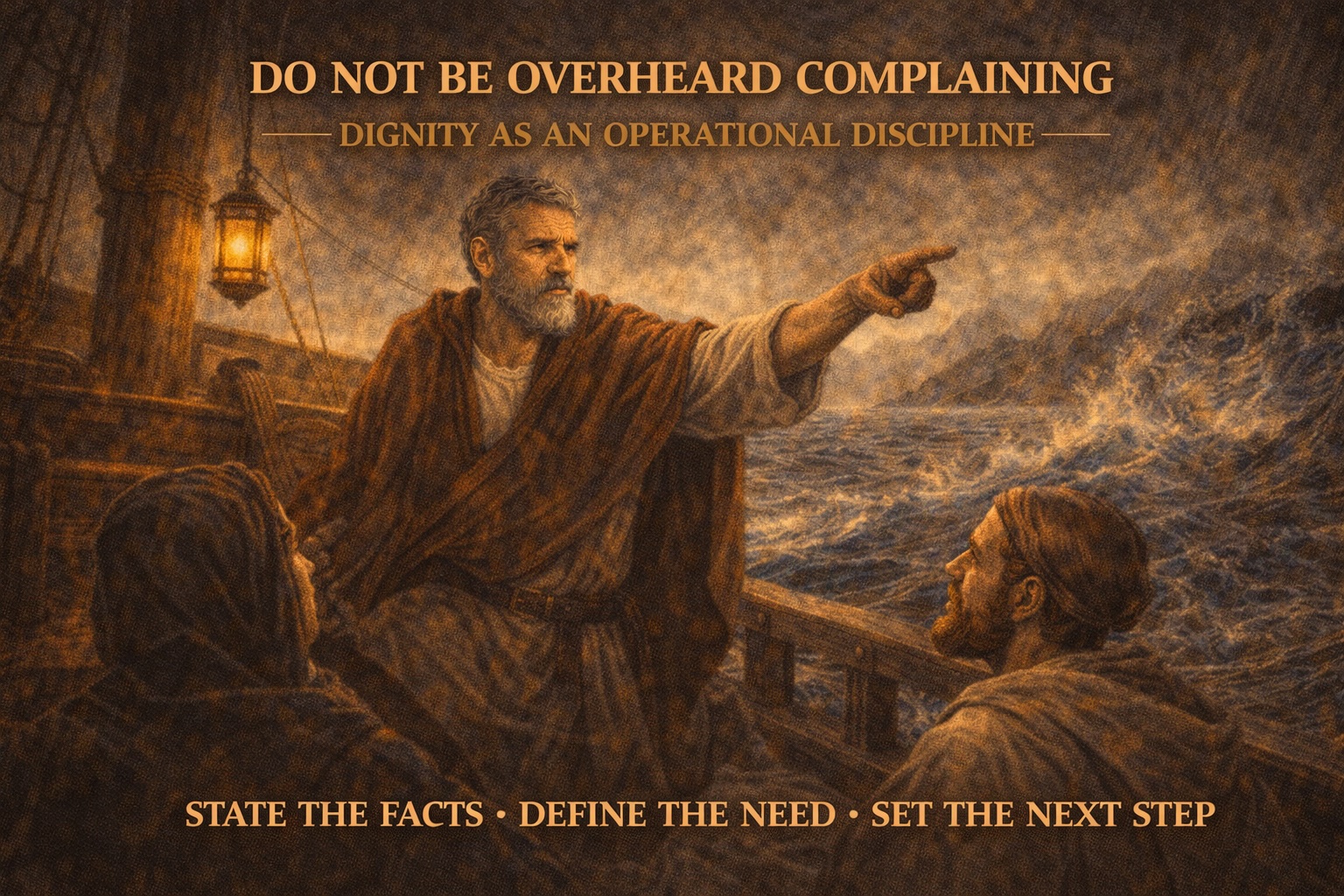
Do Not Be Overheard Complaining: Dignity as an Operational Discipline
Marcus Aurelius’ line—“Do not be overheard complaining”—reads like manners, but it is closer to operating doctrine. In work that carries real consequence, complaint is a leak: of attention, cohesion, and judgment. Stoicism treats complaint as a failure of inner discipline not because pain is unreal, but because misdirected speech turns pain into noise. Dignity in suffering is restraint with a purpose.
Complaint Is a System Behavior
Every system produces byproducts. Under pressure, the human system vents. In a cockpit, on a bridge, in an incident channel, venting multiplies risk. It adds entropy at precisely the moment a team needs signal. The habit of complaint trains an organization to narrate discomfort instead of reducing it.
-
Complaint consumes scarce bandwidth. Attention shifts from the situation to self.
-
Complaint teaches a pattern. New people watch what earns airtime and copy it.
-
Complaint externalizes responsibility. “They should” delays “Here’s what we will do.”
The fix is not repression. It is routing. Move emotional energy into structure: observation, constraint, decision.
Restraint Is Not Silence
Refusing to complain is not refusing to speak. It is choosing the channel and the format.
-
Report facts, not grievance. “We’re 30 minutes behind, fuel is at 40%, weather closing in from the west.”
-
Name the effect. “Delay compresses our safety margins.”
-
State the need. “We need a go/no-go by 1430.”
-
Propose the next step. “Recommend we adjust course 5°.”
Restraint keeps communication operational. Healthy organizations encourage risk reporting, dissent, and course correction—without performative suffering.
What Complaint Broadcasts When Stakes Are Real
Leaders broadcast more than they intend. Under stress, a leader’s complaint transmits:
-
Loss of bearing. If you lose your center, others will lose theirs.
-
Misalignment with role. Your job is to metabolize uncertainty into action.
-
Permission for noise. Teams take the emotional floor you set.
A durable alternative: state reality plainly, accept responsibility proportionate to your role, and move the team one clear step forward. In a storm you don’t narrate the cold; you trim the sail.
Practices to Convert Complaint into Action
Discipline is built from small, repeatable moves. These have held up for me across software, ships, and teams:
-
Shift the verb. Replace “should” with “is/does/next.” “The API should be faster” becomes “The API returns p95 of 1.8s; next, we cache responses.”
-
Translate feelings into constraints. “I’m frustrated” becomes “Blocked by missing approvals; critical path stalled.”
-
Time-box the human reaction. Vent privately for two minutes; then write the problem in one sentence and choose a first action.
-
Maintain a friction log. Capture recurring pain points during execution; address them in a dedicated forum, not in the live channel.
-
Use structured reviews. After-action reports and blameless postmortems turn pain into learning with names, timelines, decisions, and improvements.
-
Keep bearing physical. Breathe, lower your voice, reduce words. Posture and tempo carry more than content.
-
Write to dispose, not to perform. Draft the sharp email; delete it. File the structured issue instead.
Restraint is not ascetic theater. It is energy management.
Systems and Software: Reduce Noise, Increase Signal
Technical systems model the same principle.
-
Logging vs complaining. Good logs are structured, minimal, time-aligned. Bad logs emote and flood the channel.
-
SLOs and thresholds. Define what “suffering” means numerically before the incident. In the moment, you act on thresholds, not vibes.
-
Incident roles. Clear command, communications, and operations prevent narrative drift.
-
Postmortems. No blame, high accountability. We examine conditions, not character; behavior, not identity. Then we make one durable fix.
Treat your organization like an engineered system: reduce noise, preserve optionality, and encode lessons so you don’t suffer the same way twice.
AI Is an Amplifier—Choose What You Feed It
Intelligent tools will happily scale your complaint into essays, threads, and dashboards of indignation. That is automation without understanding.
Use AI to sharpen thinking, not to broadcast frustration:
-
Summarize raw input into facts, constraints, options, and risks.
-
Generate checklists, playbooks, and decision trees you will actually use.
-
Stress-test plans with “what would fail first?” prompts.
Tools should compress time-to-clarity, not expand time-to-performance.
When Refusal to Complain Becomes Complicity
There are moments when silence is cowardice: unsafe orders, ethical violations, systemic harm. Stoic restraint never forbids moral witness.
-
Escalate through defined channels with specific evidence.
-
Document contemporaneously.
-
Tie objection to mission, safety, law, or values—not ego.
This is still restraint: disciplined speech, accountable action.
Dignity Under Pressure
“Do not be overheard complaining” is not an aesthetic. It is operational dignity—the kind that survives weather, outages, market shocks, and personal loss. It protects the team’s attention, your own judgment, and the integrity of the work.
When pain arrives, acknowledge it privately, encode it precisely, and move. Clarity without context is brittle; action without clarity is waste. The balance is leadership.
If this perspective resonated, subscribe to The Rissler Perspective for future essays on leadership, systems, and disciplined judgment.