
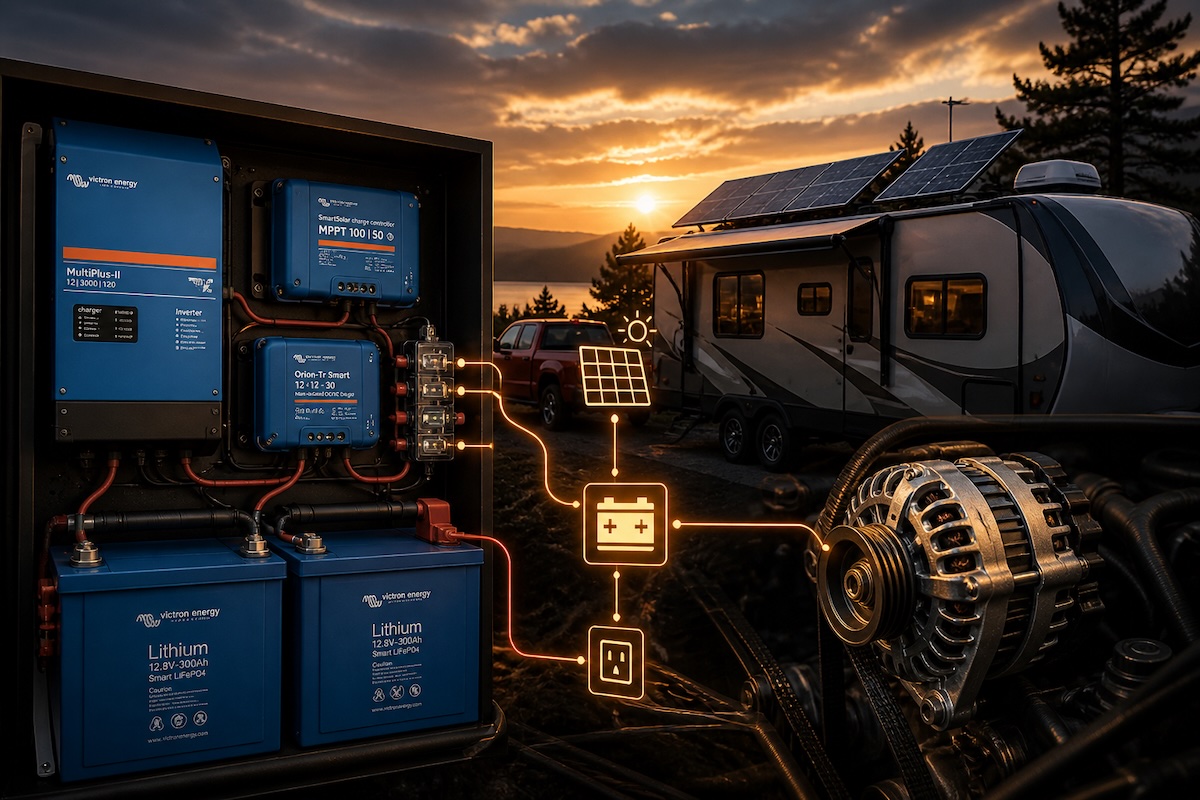
What Yacht Redundancy Teaches Us About Boondocking Confidence
When you live on a 74-foot motor yacht, you get real familiar with one word: redundancy.
On the water, a single-point failure can go from “mildly annoying” to “this just got serious” very fast. So boats—especially cruising yachts—are built and upgraded around backup systems, alternate power paths, and ways to keep the lights on when something important decides to die at the worst possible moment.
We will take those same principles into our RVs, our boondocking life will improve. Less anxiety. Fewer “uh oh” moments at 2 a.m. More confidence to push further off-grid without feeling reckless.
This isn’t about adding fancy gear just to brag about your setup. It’s about building smart, simple redundancy—parallel battery banks, dual charge paths, and fault isolation—so one failure doesn’t end your trip.
Here’s how the yacht mindset translates directly to boondocking.
Why Redundancy Matters More Than “Bigger Everything”
On Empire (our Hatteras), more capacity is nice, but what really buys peace of mind is options.
- Multiple ways to charge batteries
- Multiple ways to power critical loads
- Ways to shut off a failing component without taking the whole system down
RVers often go straight for biggest lithium bank, biggest inverter, biggest solar array. That’s fine—until one critical component fails and your “monster” system is suddenly 100% offline.
The boat taught us a better goal: design for graceful failure.
- If one bank dies, you limp along on another.
- If one charge path goes bad, you still have a backup coming in.
- If one circuit misbehaves, you isolate it instead of sacrificing the whole rig.
You don’t need yacht money to do this. You just need to think like a systems tech, not an Instagram electrician.
Parallel Battery Banks: Power Without a Single Point of Failure
In an RV, that can look like this:
1. Two Smaller Banks Instead of One Giant One
Instead of one 600Ah bank:
- Run two 300Ah banks (or similar) in parallel-capable configuration.
-
Each bank has its own:
- Main fuse
- Disconnect switch
- Positive/negative bus connection
Normally, both banks feed a shared DC bus. But here’s the key: you can turn one off and the rig still works.
If:
- A battery BMS locks out
- A cable overheats
- A fuse blows on one side
You can:
- Isolate that bank
- Run on the remaining one
- Troubleshoot when you’re not in a Walmart parking lot at midnight
2. Dedicated “Critical Loads” Battery
Borrowed straight from yacht playbooks:
-
Keep a small, dedicated battery (could be AGM or a small lithium) just for:
- Furnace fan
- Water pump
- Basic lights
- Communications (router, cell booster)
- Feed those from a protected DC sub-panel.
Your main house bank can do all the heavy lifting—induction cooktop, inverter loads, etc. But if that system throws a tantrum, your basic life-support still has juice.
You’re not sitting in the dark because your “smart” system bricked itself.
Dual Charge Paths: More Ways to Fill the Tank
Yacht rule: don’t rely on a single way to charge your batteries.
The ocean taught us that alternators fail, solar disappears in bad weather, shore power trips breakers… and it usually happens when you’re tired and far from help.
In an RV or overland rig, build at least two solid, independent charge paths:
1. Solar + Alternator (or DC-DC)
-
Solar:
- Primary off-grid charger
- Great for long stays
- Quiet, low-maintenance
-
Alternator via DC-DC charger:
- Great for travel days
- Doesn’t care if it’s raining
- Can rescue a low bank quickly
If the sun ghosts you for a week, driving into town isn’t just for snacks—it’s a charging strategy.
2. Shore Power + “Emergency” Charging
Even if you boondock 90% of the time, have shore as a clean, well-behaved charge source:
- Inverter/charger or standalone smart charger
- Properly sized shore cord and breaker protection
Then, add a third-layer backup:
- Small, reliable generator (quiet inverter style if possible), or
- Portable panel + dedicated backup charge controller you can clip directly to the bank
This doesn’t have to be pretty. It just has to work when everything else doesn’t.
Fault Isolation: How Boats Turn Chaos Into “Minor Annoyance”
Most of the “oh no” moments we’ve had on the yacht were saved by one thing: the ability to isolate the problem fast.
You can bring that same calm to your RV boondocking setup with a few habits and parts.
1. Break Your System Into Zones
Instead of one spaghetti mess of wires feeding everything, create “zones”:
-
Charging zone:
- Solar controller(s)
- DC-DC charger
- Shore/generator charger
-
Storage zone:
- Banks 1 and 2
- Fuses and disconnects per bank
-
Load zone:
- Inverter + AC subpanel
- DC fuse panel for lights, pumps, fans
- Dedicated circuits for “heavy hitters” (fridge, AC, microwave)
Each zone should have:
- A main fuse/breaker
- A labeled switch or disconnect where possible
When something goes sideways, you’re flipping one or two known switches, not tearing into everything and burning daylight.
2. Use Individual Protection on Big Loads
On the boat, anything that can pull serious amps gets:
- Its own breaker
- Its own labeled feed
In the RV:
-
Put high-draw items on their own protected circuits:
- Inverter
- DC fridge
- Air compressor
- Electric heaters (if you ever use them)
- Don’t daisy-chain multiple heavy loads on one mystery circuit “because it works.”
When the inverter trips a breaker, you can still run fans and the water pump. That’s the difference between “annoyed” and “miserable.”
Avoiding the “More Gear, More Chaos” Trap
Redundancy only helps if you actually understand and can operate the system. This is where a lot of builds fall apart.
From both the yacht and the RV, here’s what kept our sanity intact:
-
Paper diagrams in the rig
Simple, hand-drawn or printed wiring diagrams taped inside a cabinet. If something fails in the dark, you don’t want to rely on memory or buried PDFs. Although a digital version is also super useful! -
Labels everywhere
On the yacht, if a wire isn’t labeled, we assume it’s a future problem. Use heat-shrink labels, tape, label makers—whatever. Just don’t leave mystery cables. -
Standardize where you can
Fewer charger brands, a consistent wire color scheme, similar breakers/fuses. Makes spares and troubleshooting easier. -
Test failure modes on purpose
Turn off one bank and run on the other. Unplug shore and watch what happens. Kill solar with a blanket and see what your alternator/DC-DC setup actually does. Better to discover the weak links in your driveway than three hours down a washboard road.
What This All Adds Up To: Quiet Confidence, Not Fragile Bravado
Living on a yacht taught us that freedom doesn’t come from pretending things never break. It comes from knowing what happens when they do—and having a plan.
For RVers and overlanders, that means:
- Parallel battery banks instead of one fragile monster
- Multiple independent charge paths, not betting it all on sunshine
- Clear fault isolation, so every problem isn’t a five-alarm fire
You don’t have to turn your rig into a shipyard science project. Even a few simple changes—like splitting your bank, adding a DC-DC charger, and installing real disconnects—can turn boondocking from “hope it works” into “we’ve got options.”
If you want more behind-the-scenes breakdowns of how we’re blending yacht systems thinking with real-world RV use, follow along with Anchors to Axles—we’ll keep sharing what worked, what failed, and what we’d build differently next time.