
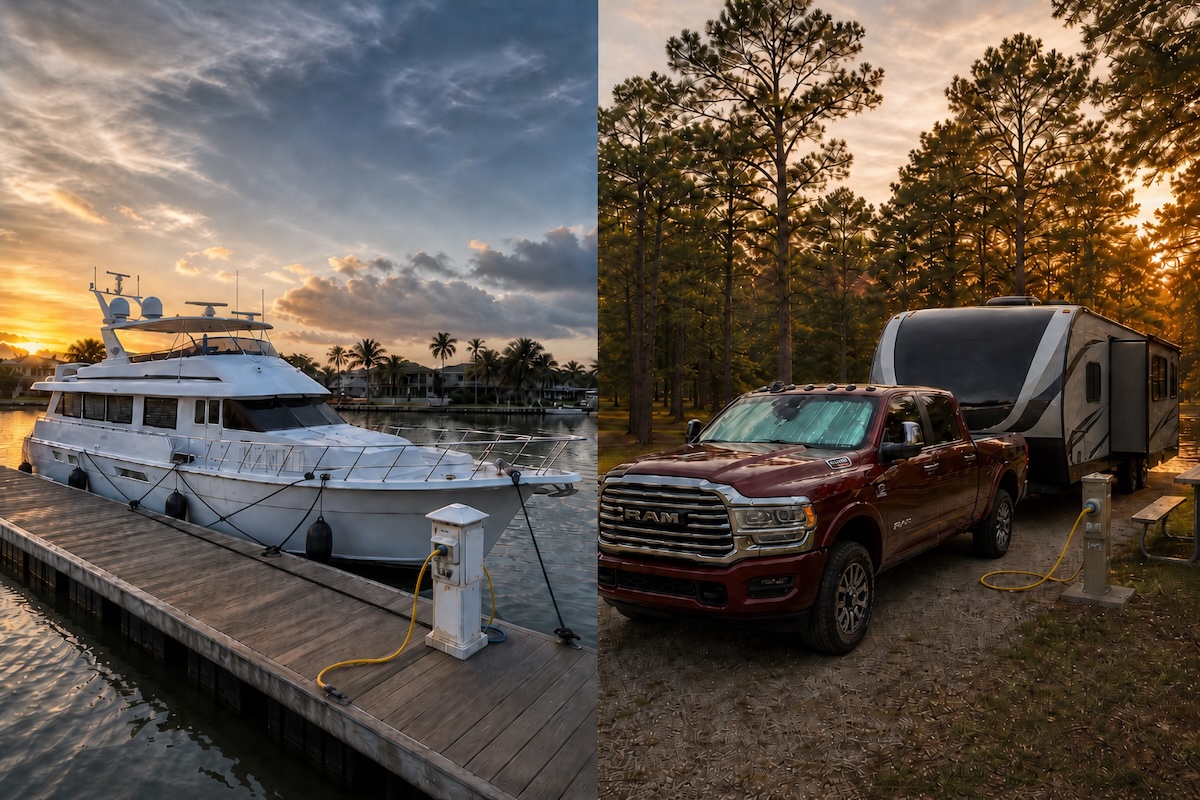
How to Choose a Weather Window Like a Pro (Bay or Mountain Pass)
Picking the right weather window is the difference between a great story and a being stressed out all day. On our 74-foot Hatteras, Empire, we’ve crossed glassy rivers at dawn and rough ocean voyages that made us question our life choices.
Below are three go/no-go rules you can start using today—built for both sides of the Anchors to Axles life. They’re simple, repeatable, and honest about the tradeoffs we all face out there.
Rule 1: The Agreement Rule — Don’t Go Unless Two Independent Forecasts Match and the Trend Is Improving
Pros don’t hang a decision on a single app. They compare, then watch the trend.
- Water: Check at least two marine forecasts (NOAA/NWS marine zones + a model viewer like Windy or PredictWind). You want direction, sustained wind, and gusts within ~20% agreement, wave height/period telling the same story, and a pressure trend that’s steady or rising.
- Road: Pair DOT road cams/alerts with a weather model (NWS point forecast, Windy, or other apps). Look for alignment on snowfall rate, wind gusts, freezing levels, and timing of any front or squall line.
If two out of three sources agree and the next six hours are stable or easing, you’ve got a window. If the spread is wide or the trend is worsening, the window is imaginary.
Rule 2: The Margin Rule — Keep a 30% Buffer Between Forecast and Your Personal Limits
Your limits are based on your boat, rig, crew, and experience. The forecast is not your limit; it’s a line you stay well inside.
-
On the water:
- If your comfortable limit is 20 knots on the nose in short fetch, don’t depart on a forecast of 15 gusting 25. Gust factor matters: if gusts exceed sustained wind by 30%+ and the period is short, seas will be square and mean.
- Wave period beats height: a 3 ft chop at 4 seconds can hurt more than 5–6 ft at 10 seconds. As a quick filter, aim for wave period at least 2x the wave height (in feet) for a reasonably comfortable ride in most planing/powerboats.
- Tides and current magnify everything. Wind against current is an automatic margin shrink—treat forecasts as 20–40% worse in those zones.
-
On the road:
- Crosswinds are the trailer killer. If you’re comfortable up to 30 mph crosswind, hold your go/no-go line at 20–22 mph forecast gusts, not 29. Bridges, passes, and gaps can spike gusts 10–20 mph above the area forecast.
- Snowfall rate is king. We’ll drive through 2–4” total if the rate stays under 0.5”/hr, but we park it when rates exceed 1”/hr with temps hovering around freezing—slick, churned slush and poor plow efficiency.
- Ice beats confidence. Subfreezing road temps after precipitation, or any mention of freezing rain, should expand your margin dramatically.
Build your margin into timing, too. Leave earlier to buy daylight, fuel, and patience.
Rule 3: The Exit Rule — Always Have Two Outs
No plan survives first contact with weather. Pros use outs as alternate plans when weather changes.
- Water: Before you untie, have two alternatives, a mid-route anchorage, and one full retreat option. For bar crossings and inlets, your “out” might be “wait for slack/high water” or “sit tight behind the breakwater until the ebb eases.”
- Road: Identify chain-up areas before the grade, safe pullouts with wind breaks, and an overnight option below the pass. If the pass closes, you already know where you’ll turn around or wait it out.
Time your window so you can abort without racing sunset. Our rule: depart with enough daylight to complete the route plus one extra hour—whether that’s a bay hop or a snowy pass.
Quick Checks Before You Commit
Water: 60-Second Window Checklist
- Wind direction vs. fetch and current (especially inlets and river bars)
- Sustained vs. gusts (gust factor under 1.3 is friendlier)
- Wave height and period (aim for period ≥ 2x height in feet)
- Tide stage at choke points (avoid wind-against-current)
- Pressure trend and frontal timing (avoid the leading edge)
- Visibility and sea fog risk (temp/dew point spread)
Road: 60-Second Window Checklist
- Gusts and direction relative to your route (true crosswind exposure points)
- Snowfall rate and snow level vs. your pass elevation
- DOT alerts: chain controls, metering, avalanche control windows
- Road temperature vs. air temperature (black ice risk)
- Plow cadence and timing—follow the lull behind the plows
Timing Tactics That Stack the Odds
- Leave early. Mornings often offer lighter winds and colder, drier snow that’s easier to plow.
- Chase lulls, not zeros. You don’t need “perfect,” you need “good enough with margin.”
- For bars and inlets, target slack or a flooding tide; for passes, time the lull after an active snowband and before the next wave.
- Shorten the route. On the water, tuck inside the lee; on the road, drop to the lower, longer route if the high pass is spiking.
Red Flags That Flip a Green Light to Red
- Rapidly falling barometer or tightening isobars on model maps
- Thunderstorm squall lines, convective gusts, or outflow boundaries
- Gale warnings or small craft advisories you were hoping to “beat”
- Forecast spread widening across models as departure nears
The Bottom Line
Choosing a weather window like a pro isn’t magic—it’s habits. Get two forecasts that agree, keep a 30% margin, and never leave without exits. Do that consistently and you’ll stack safe, smooth passages on both water and road, with fewer “what were we thinking?” moments.
Want more real-world window calls, route notes, and the gear that actually helps? Subscribe to Anchors to Axles and follow along as we keep learning—on the dock, in the engine room, and over the next mountain pass.