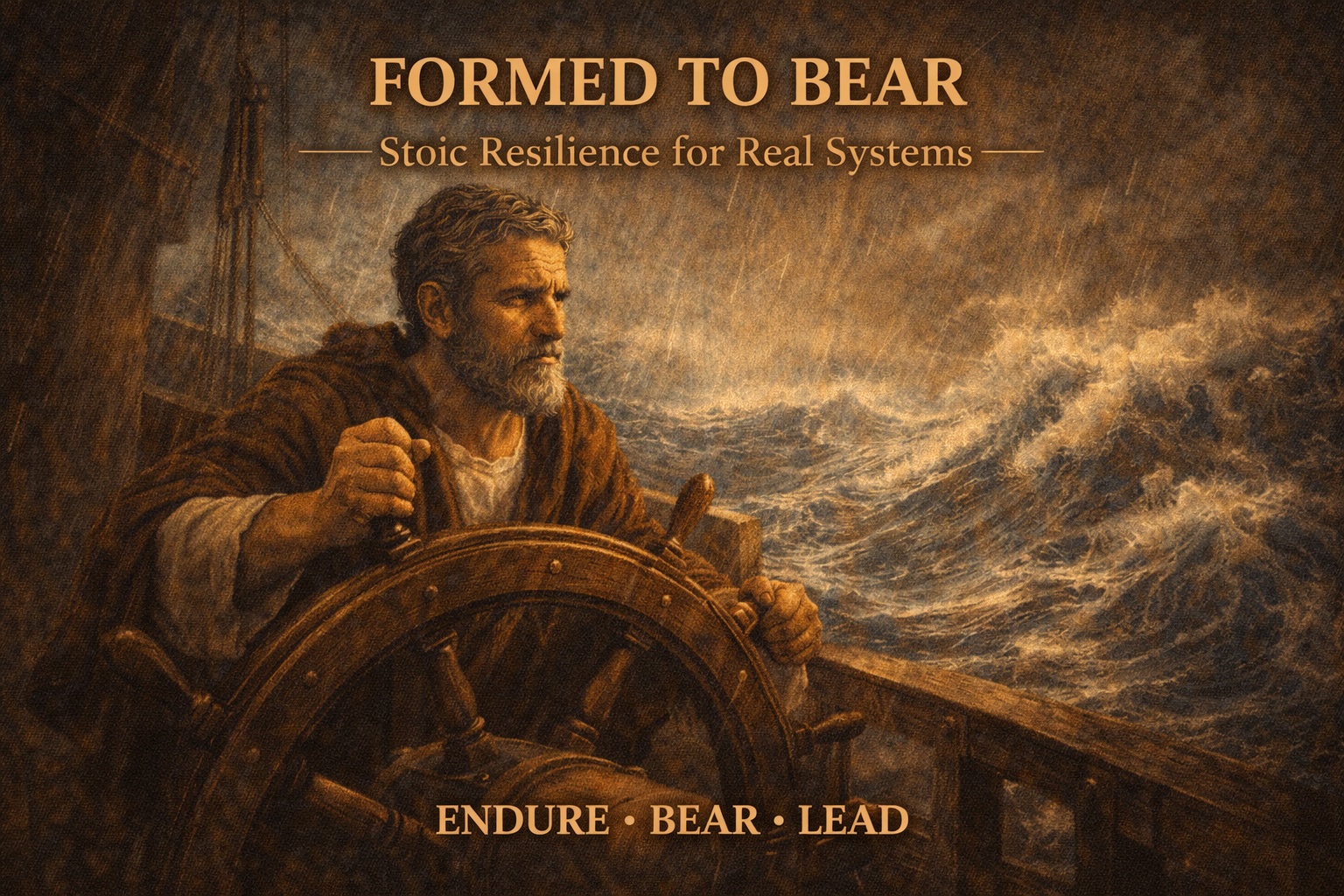
Formed to Bear: Stoic Resilience for Real Systems
In Book II, Section 17 of Meditations, Marcus Aurelius writes: “Nothing happens to any man which he is not formed by nature to bear.” It is not bravado. It is a design assumption about being human. Resilience is not performance; it is a steady trust that our rational nature can meet reality, even when it is indifferent and heavy.
This is how I read the line as a practitioner: a captain on rough water, an engineer in a failing system, a leader when people are watching for your next move. Endurance is not a mood. It is a disciplined relationship with load, limits, and responsibility.
Endurance as a Design Principle
Good systems assume turbulence. Ships have bulkheads. Software services degrade gracefully. Units drill for friction. Leadership requires the same posture.
“Formed by nature to bear” doesn’t mean we will not break. It means:
-
We have agency over judgment and action in the present.
-
We can separate what is ours to manage from what is not.
-
We can choose meaning and method under pressure.
In practice, resilience is less about feeling strong and more about organizing attention and duty when it matters.
What Nature Actually Gives Us
Human nature equips us with a few reliable tools:
-
Perception: to see the situation without decoration.
-
Reason: to orient against facts, not fantasies.
-
Choice: to act within our span of control.
-
Adaptation: to learn and reconfigure after contact.
At sea, this looks like reefing early, plotting a secondary harbor, logging conditions, and keeping hands clear when a line is under strain. In software, it means you know your load paths, you design for failure, and you have a practiced rollback. In command, it means you define the ground truth, set a tempo, and keep decisions reversible when possible.
These are not hacks. They are expressions of a nature shaped to carry weight with judgment.
Load, Limits, and the Leader’s Responsibility
Stoic strength is not an excuse to overload people or systems. A hull rated for a certain sea state can be destroyed by arrogance. Teams fail when leadership treats resilience like an inexhaustible resource.
-
Load belongs on structures designed to carry it.
-
Slack is not waste; it’s what keeps systems from shattering.
-
Boundaries are discipline, not indulgence.
If you’re responsible for others, your job is to shape the load: clarify roles, reduce noise, build redundancy where it matters, and refuse to make “heroics” a plan. Confidence in human resilience must be matched with humility about human limits.
Practices That Turn Endurance Into Method
Resilience is built before the storm and expressed during it. A few practices transfer across domains:
-
Pre-mortems and red teaming: map failure modes and decision points when calm.
-
Minimum viable response: define the smallest, safest action that preserves options.
-
Standard work for crisis: who calls who, what is paused, what thresholds trigger escalation.
-
Breathing and cadence: a physical reset before a critical order or deploy.
-
After-action reviews: brief, honest, and oriented to systems change, not blame.
Design Systems to Bear Reality
If you want people to bear, give the system backbone:
-
Bulkheads and circuit breakers: isolate failure to protect the whole.
-
Graceful degradation: prefer partial service to total collapse.
-
Single points of failure: identify and eliminate them ruthlessly.
-
Budgets for error and recovery: time, fuel, bandwidth, human energy.
These principles apply in code, on deck, and in organizations. They translate Stoic acceptance into structural resilience.
Using AI Under Pressure, Without Abdication
AI can help carry cognitive load—summarize logs, surface anomalies, propose options. Use it as a bulkhead, not a captain.
-
Ask for ranges and trade-offs, not certainties.
-
Keep the human loop tight for decisions with ethical or irreversible consequences.
-
Log prompts and outputs during incidents for accountability and learning.
Automation without understanding is brittle. The point of tools is sharper thinking and better choices—not escape from responsibility.
What This Line Does Not Mean
It is not a command to feel fine. Pain is real. Loss is real. Trauma can exceed present capacity. “Formed to bear” is a direction of travel, not a judgment on the suffering.
It is not fatalism. Acceptance of conditions is the starting line for action, not a reason to stand still.
It is not a license for negligence. If someone is drowning, you throw the line. Resilience does not absolve duty.
A Quiet Confidence
There are hours when theory breaks—night watches with failing gear, budgets that do not close, systems paging at 3 a.m., conversations that redraw a life. In those hours, “formed to bear” is not a slogan. It’s a quiet inventory:
-
What is true right now?
-
What is within reach?
-
What is the next right action?
-
What must be protected from cascading failure?
We act, we learn, we repair. Endurance is not perfection. It is continuity of judgment under load.
Marcus closes the section with confidence in human resilience. We earn that confidence by matching calm with preparation, trust with structure, and acceptance with action. Nature formed us to bear. Our job is to meet that design with craft.
If this perspective is useful, subscribe to The Rissler Perspective for future essays on leadership, systems, and responsible integration of humans and AI.