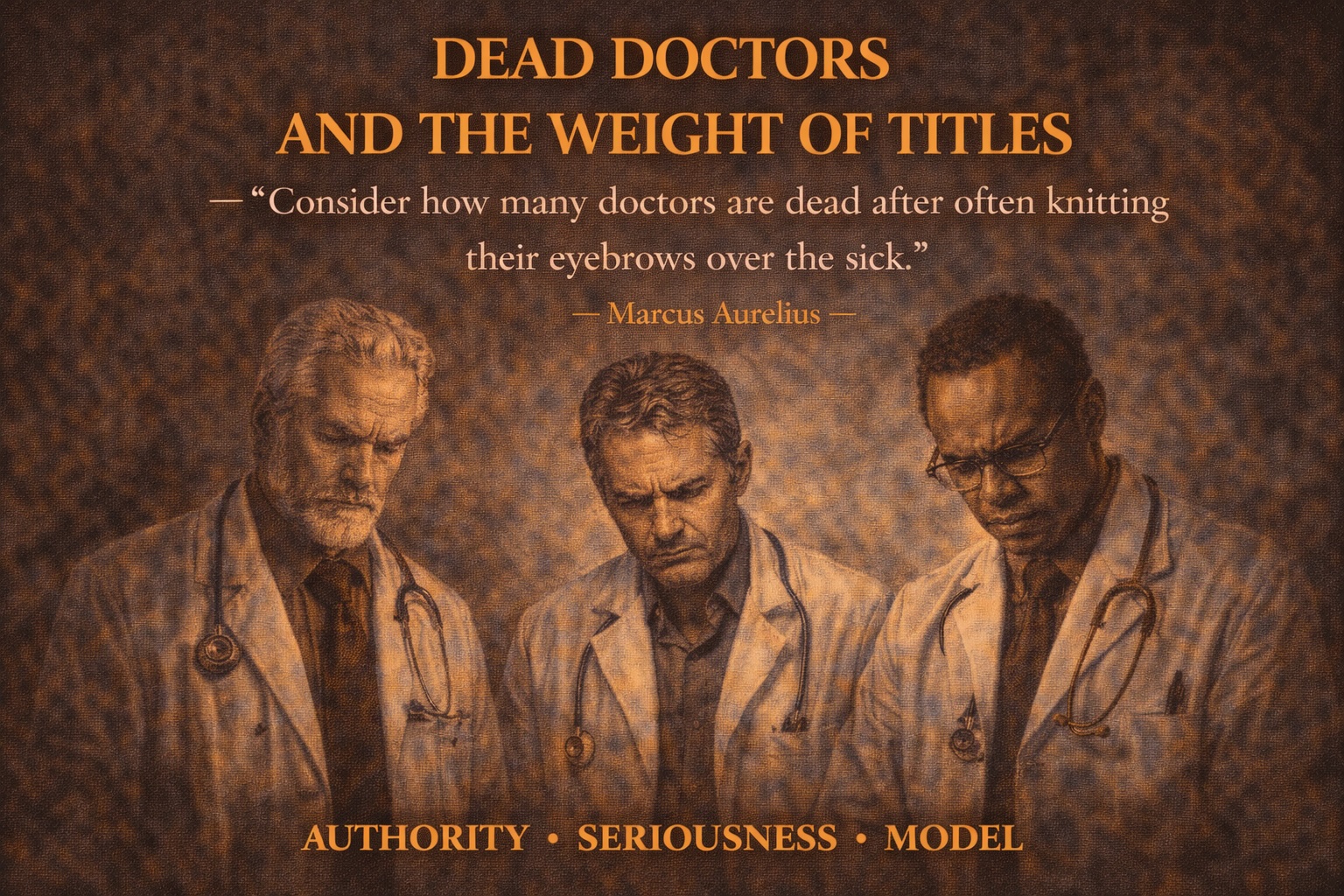
Dead Doctors and the Weight of Titles
“Consider how many doctors are dead after often knitting their eyebrows over the sick.”
Marcus Aurelius wasn’t dismissing medicine. He was stripping away the illusion that expertise and grim seriousness confer immunity from the basic terms of life. The frown of authority, the title on a badge, the meetings and models—all of it shares the same end point. Mortality is the equalizer. For leaders, architects, and operators, that recognition is not nihilism. It’s orientation. It resets the frame from status to stewardship, from performance to responsibility, from speed to durability.
Titles Don’t Survive Contact with Time
In every domain I’ve worked—the bridge of a yacht in heavy weather, a software architecture review, a military watch change—there’s a familiar theater: confident posture, dense vocabularies, furrowed brows. Some of it is earned; much of it is camouflage. The doctor’s knitted eyebrows are a signal of seriousness. But signals are not outcomes. The storm doesn’t care. Production doesn’t care. Time doesn’t care.
Stoic humility begins with that clarity. We can respect craft and demand results while refusing to worship status. When we remember that doctors die, captains retire, founders age, and systems decay, we are freed to value what lasts:
-
Decisions that compound well over time
-
Systems that fail safely and can be repaired
-
Teams that function without a single hero
-
Habits that reduce noise and sharpen judgment
Expertise Without Humility Is a Fragile System
Authority can stabilize a team. It can also hide fragility. When expertise becomes identity, we stop learning and start defending. The work shifts from seeing the system to protecting our place within it. That is how ships run aground in clear weather and how architectures ossify under the weight of cleverness.
Humility is not self-deprecation. It’s precision about what we know, what we don’t, and what the environment can do to us regardless. It shows up operationally:
-
We design for handover because none of us is permanent.
-
We write plainly because clarity outlives charisma.
-
We choose integration over optimization because long-term conditions change.
-
We measure real-world behavior over internal narratives.
Mortality becomes a design constraint: this must work when I am not here; someone else should be able to maintain it; the next person must inherit clarity, not mystery.
Decision-Making Under Uncertainty: Practices That Survive
Leaders don’t remove uncertainty; they set conditions to act well inside it. Stoic humility turns into practical discipline:
-
Pre-mortems: Before committing, ask how this fails and who gets hurt. Name the obvious and the unthinkable. Adjust now.
-
Red-team by default: Invite contradiction. Critique is cheaper than catastrophe.
-
Commit to thresholds: Define in advance what triggers a pause, an escalation, a return to port.
-
Checklists that matter: Short. Verifiable. Tied to consequences. On a bridge or in a deploy pipeline, checklists protect attention.
-
After-action reviews: No theater. No blame. What happened, why, and what changes tomorrow. Publish the findings to the people who live with the outcomes.
These are not rituals to perform for status. They are scaffolds for judgment. When pressure rises, they keep leaders honest and teams coordinated.
Designing Systems for Impermanence
Systems shape behavior long after their designers move on. If mortality is the context, then durability becomes the metric.
-
Reduce single points of failure: People, components, vendors. Raise the bus factor. Cross-train.
-
Favor graceful degradation: When parts fail, the system should limp, not shatter. On a vessel, that’s manual steering readiness. In software, it’s timeouts, backpressure, and sane defaults.
-
Build observability in: Log what matters. Name it clearly. If you can’t see it, you can’t steer it.
-
Maintain the maintenance: Spare parts, drills, documentation that a new watchstander can use at 0200. In engineering, living docs over grand diagrams.
-
Simplify interfaces: Every dependency is a promise to the future. Make fewer promises. Keep them.
Clarity without context is incomplete. Documentation must live where work happens, use the language of the operators, and reflect actual configuration—not aspirational architecture.
AI and Automation: Tools, Not Talismans
The knitted eyebrow has modern cousins: a dashboard covered in metrics, a model overfit to last quarter, a generative AI that answers confidently without understanding. Automation amplifies both discipline and delusion. It is useful only insofar as it supports better human decisions.
Set boundaries:
-
Purpose: What decision does this tool inform? What decision does it never make?
-
Accountability: Who owns outcomes? Tools don’t apologize.
-
Validation: Regularly test against reality, not just test data.
-
Fail modes: If the system goes dark, what’s the manual path? Who is trained on it?
AI can compress time, surface patterns, and reduce noise. It cannot absorb responsibility. Keep human judgment in the loop, explicitly and audibly.
Leadership Measured Over Time
Aurelius reminds us: the posture will pass. What remains is the trail of consequences. Leadership, then, is less about projection and more about stewardship—of systems, standards, and people who will still be here when we’re not.
Operationalize that stance:
-
Replace heroics with habits
-
Replace opacity with legible intent
-
Replace urgency with cadence
-
Replace cleverness with coherence
Memento mori is not dark. It is liberating. It removes the burden to appear in control and replaces it with the duty to build what endures.
A Practice Worth Keeping
Before the meeting, the watch, the deployment, remember the dead doctors—skilled, serious, and still mortal. Let that memory lower your shoulders and sharpen your eye. Ask: What matters here? What will matter in five years? What will matter when I’m gone?
Then act accordingly. Less theater. More stewardship. Systems that last because they were built by people who knew they wouldn’t.
If this perspective is useful in your own work across leadership, engineering, or the sea, subscribe to The Rissler Perspective and continue the conversation.